Menu

 Find Your
Car
Find New
Car
Local
Pages
Find Your
Car
Find New
Car
Local
Pages
 Pakistan
 Antigua
 Anguilla
 Armenia
 Australia
 Azerbaijan
 Bahamas
 Bangladesh
 Botswana
 Burundi
 Canada
 Chile
Chile
 Costa Rica
 Cyprus
 Dominican Republic
 Fiji
Fiji
 Georgia
 Ghana
Ghana
 Guatemala
 Guyana
 Ireland
 Jamaica
 Kenya
Kenya
 Kyrgyzstan
 Lesotho
 Malawi
 Micronesia
 Mongolia
 Mozambique
 Namibia
 New Zealand
 Nigeria
 Papua New Guinea
 Paraguay
 DR Congo
 Russia
 Rwanda
 Samoa
Samoa
 Solomon Islands
 Somalia
 South Africa
 South Sudan
 Sri Lanka
 Tanzania
 Tonga
Tonga
 Uganda
 Ukraine
 USA
USA
 Zambia
 Zimbabwe
Car
Services
Company
Overview
Reviews
Blogs Categories
Help
Explore Stock
Explore Stock
Explore By Price
Explore By Price
Explore By Make
Explore by
Type
Explore by Year
Explore by
Discount
Inventory
Location
Inventory
Location
Other Categories
Other Categories
Zimbabwe
Car
Services
Company
Overview
Reviews
Blogs Categories
Help
Explore Stock
Explore Stock
Explore By Price
Explore By Price
Explore By Make
Explore by
Type
Explore by Year
Explore by
Discount
Inventory
Location
Inventory
Location
Other Categories
Other Categories


In a Four-Wheel Drive (4WD) system, the power is distributed to all four wheels of a vehicle, which improves traction and stability across various road conditions. This can significantly benefit you if you’re driving through mud, snow, or uneven landscapes. There are a couple of primary settings within this system, called Four-High (4H) and Four-Low (4L). In this article, we will break down what’s the difference between 4H and 4L, when to use each setting, and other relevant details.
Understanding Four-Wheel Drive (4WD) Basics
Four-wheel drive (4WD) systems improve vehicle traction by distributing power to all four wheels, unlike two-wheel drive systems that only deliver power to the front or rear wheels. The transfer case is the heart of this kind of system, as it distributes power from the vehicle’s transmission to the rear and front axles.
The torque split between the axles can vary based on the system’s design and the driving conditions. This system can significantly benefit you in off-road scenarios. For instance, if you are driving through a muddy trail, a 4WD system can distribute torque to all wheels and reduce the probability of getting stuck.
What’s the Difference Between 4H and 4L?
Although both settings engage all four wheels to improve traction, there is some slight difference in 4H and 4L based on the purpose they serve according to driving conditions and speed requirements.
4H (Four-High)
When you engage the 4H, the vehicle’s front and rear axles are locked together, resulting in all four wheels being driven forward simultaneously while maintaining high-range gearing. You can use this setting if you need additional traction but do not want to give up speed, such as in wet or snowy areas, unpaved roads, or snowy paths.
4L (Four-Low)
Although activating 4L locks the front and rear axles together, it also engages additional gearing, offering more torque at significantly decreased speeds. You will need this setting when driving through challenging terrain where maximum control and power are needed.
Some use cases of 4L include steep inclines or declines, such as tackling a steep, rocky hill during an off-road adventure. This setting can also help you get out of heavy snow or deep mud pits.
Many modern SUVs, such as luxury models like the 2025 BMW X5, use intelligent all-wheel-drive systems that automatically adjust torque distribution based on driving conditions.
4 Wheel High vs Low: When to Use Each Setting
You must engage the correct four-wheel-drive (4WD) to ensure your vehicle performs well and remains safe in various driving conditions. See the table below to understand whether to use 4 wheel high vs low in each situation and how it would help.
Scenario
Recommended Setting
Reason
Wet pavement
4H
Enhances traction and stability at moderate speeds.
Snowy or icy roads
4H
Provides balanced power for improved control on slippery surfaces.
Deep snow or steep icy inclines/declines
4L
Delivers maximum torque and controlled speed for challenging conditions.
Moderate steep inclines/declines
4H
Maintains momentum on firm surfaces.
Steep, loose, or uneven inclines/declines
4L
Offers increased torque and engine braking for safe navigation.
Shallow mud or sand
4H
Helps maintain higher speeds to prevent bogging down.
Deep mud or sand
4L
Ensures slow, deliberate movement to maintain traction.
Towing on smooth surfaces with some slip
4H
Allows for normal speed maintenance with added traction.
Towing on rough, uneven terrain
4L
Provides maximum torque and control for safe maneuvering.
Common Misconceptions About 4H and 4L
Misconception 1: "You Can Use 4L on the Highway"
It’s not recommended to use 4L on highways, as it can cause severe drivetrain damage. This setting is designed for low-speed, high-torque situations like deep mud or rocky terrains. On a highway, the vehicle will operate at extremely high engine RPMs with limited speed, which can waste fuel and cause mechanical strain.
Misconception 2: "4H Improves Fuel Economy"
4H actually provides better traction on slippery surfaces, but it does not improve fuel economy in any way. Using it on dry surfaces can produce excessive noise and cause severe tire wear. If you drive it on a clear and well-paved road, it can lead to increased drivetrain drag and higher fuel consumption.
Tips for Switching Between 4 Low vs 4 High Safely
Shifting from 2H to 4H
You can generally shift from 2H to 4H while moving, generally up to the speeds of 55 mph. When the vehicle is moving straight, release the accelerator pedal, engage the 4WD selector to 4H, and then resume acceleration. It’s also possible to shift into 4H when the vehicle is stationary.
Shifting from 4H to 4L
You must bring your vehicle to a complete stop before shifting from 4H to 4L or slowing it down to crawl. If you have an automatic transmission, you can shift the gear lever to Neutral (N). If it’s a manual transmission, depress the clutch pedal. Then, firmly move the 4WD selector to 4L without pausing in neutral. Once engaged, return the transmission to Drive (D).
Shifting from 4L to 4H
It’s also important to stop your vehicle completely or slow it down to a crawl before shifting from 4L to 4H. Once it’s stopped, shift the transmission to Neutral (N) or depress the clutch pedal. Then, move the 4WD selector from 4L to 4H. You can then return the transmission to Drive (D) or the suitable gear and continue driving.
Conclusion
Knowing when to use 4H vs. 4L can significantly improve your vehicle’s performance across difficult terrains. Although 4H provides better traction at a normal speed for loose surfaces, 4L is the right option if you need maximum torque. There is a slight difference in 4H and 4L, and you must use the right setting for the right situation to keep yourself safe and avoid drivetrain damage to your vehicle.
SAT Japan has a comprehensive list of used and new japanese vehicles that you can explore to find the ideal one for your situation. You can filter the results based on your budget, car type, make, model year, and other relevant factors.
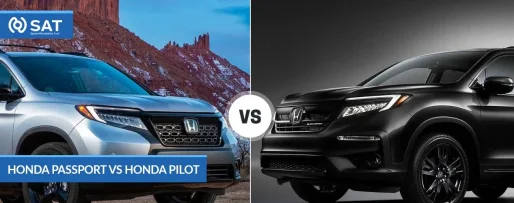
Honda is one of the first names that comes to someone’s mind when they think about cars. Having successfully produced numerous car models that are loved by car fanatics worldwide, it has become a name synonymous with reliability and innovation in the auto industry. In this blog, we will do a car comparison between the debate of Honda Passport vs Honda Pilot, to help our customers choose exactly which car would suit them better.
The 2024 Honda Pilot is larger with more seating capacity and advanced features compared to the Honda Passport. The Pilot offers more cargo space and luxury options, while the Passport is more compact and cost-effective.
For the start of Passport vs. Pilot, let us take a look at the first model of the Honda Passport that was launched in 1994. This SUV was the first of a total of three Honda Passport generations, with modifications occurring with every launch. The features of the 2023 Honda Passport are discussed below.
Space
The Honda Passport has comfortable leather-trimmed seats for five people, including two heated front seats. This vehicle has a spacious interior with ample cargo space. If the rear seats are folded down, the car has a massive trunk space of 77.7 cubic feet.
Safety
The Honda Passport has an impressive total of eight airbags. For child safety, this car is equipped with ISOFIX child seat anchors, a system that uses anchor points to secure the child seat. Other safety features include an immobilizer, child locks, vehicle stability control, and downhill assist control. Additionally, understanding driving hand signals can further enhance safety on the road by ensuring clear communication with other drivers, complementing the Passport’s robust safety features.
Comfort features
Air conditioner, heater, and a defogger
Climate control
Power steering, power boot, power windows, power mirrors, and a power door lock
Cruise control
Armrest
Electric handbrake
Cup holders
Rear folding seats
Rear AC vents.
In summary, this vehicle has outstanding interior features, so passengers can have considerable facilities during their journey.
Now, we will see the exterior of the Honda Passport. As for the Honda Passport vs Pilot dimensions, the vehicle weighs around 1914 kgs. The vehicle has alloy wheels with a wheel size of 20 inches, ensuring that the car has a firm grip on the road and the braking process remains efficient. The Honda passport also comes with a spare tire, in case of emergencies.
The Honda Passport has a six-cylinder engine that runs on petrol. The vehicle is an impressive 3471 cc and provides a standard horsepower of 280 hp at 6600 RPM. The maximum speed of this car is 220 KM/H. The fuel capacity is 74 liters. Talking about the mileage, the Honda Passport gives a mileage of 8 KM/L in the city and 11 KM/L on the highway. Hence, this car has a high petrol consumption, a critical factor to consider before the purchase.
To find out more information about the Honda Passport or other used Japanese vehicles, visit us at SAT Japan.
The first generation of the Honda Pilot came out in April 2003. This vehicle has remained one of the top choices of big car fanatics. In contrast to the Honda Passport, the Honda Pilot is currently in its fourth generation. Due to its success, this vehicle is sold globally, including continents such as Asia, North America, and Europe. The car’s features are discussed below.
Space
The Honda Pilot is huge; it has a seating capacity of eight people. This SUV allows up to 87 cubic feet of space with the second and third rows folded.
Safety
The Pilot has front, side, side curtain air, overhead, and knee airbags, so the passengers remain safe in case of any collision. The vehicle also has child locks to prevent the door from being opened from the inside. The Honda Pilot also has a blind spot information system, which alerts the driver if anything is detected in the blind spot zone.
Luxury
These features of the Honda Pilot include color touch screens, wireless Apple car play, android auto compatibility, wireless phone charging, and an internet hotspot.
Comfort
Standard air-conditioner, heater, and defogger
Heated door mirrors
Heated steering wheel
Climate control feature
Power steering, power windows, power mirrors, and a power door lock
Smart keyless entry
Aesthetic one-touch power panoramic moonroof
Now, we will describe the exterior features of the Honda Pilot. Since this is a mid-size SUV, the vehicle’s dimensions are relatively larger than average (5.08m * 1.99m * 1.8m). The weight of the car is 2086 kgs. Similar to the Honda Passport, the Honda Pilot also has alloy wheels of 20 inches, so the road grip and braking safety are not compromised.
The Honda Pilot has a fuel-run engine with a tank capacity of 70 L. The vehicle is 3498 cc and provides a standard horsepower of 285 hp at 6100 RPM. The top speed of the car is 180 KM/H. Moving on to the mileage, the city mileage for the Honda Pilot is 8 KM/L, and the highway mileage is 11.5 KM/L. This is similar to the mileage given by the Honda Passport.
To find out more information about the Honda Pilot or other used Japanese vehicles, visit us at SAT Japan.
In this blog, we went deep into the specifications of the Honda Passport and Pilot. The major difference between the two is that of size. Whereas the Honda Pilot is considerably larger than the Honda Passport, there are many interior features in the Honda Pilot as well that are lacking in the Honda Passport.
So, now that you are equipped with that knowledge, go ahead and tell us which one you like best. Or, better yet, head to our selection and choose your favorite one!

Honda is one of the leading car brands in today’s world, having produced countless models of reliable cars that are loved by car fanatics globally. Their vehicles provide stellar specifications and quality, allowing the drivers to have a ride that is smooth, powerful and comfortable all in one. In this blog, we will do a car comparison between two of Honda’s hit vehicles, the Honda CR-V vs Honda HR V, to help you out in deciding your next car.
The 2024 Honda CR-V has better space and comfort compared to the 2024 Honda HR-V. It offers more headroom, legroom, and shoulder room at the front and rear. Hence, this vehicle is ideal for taller passengers. In addition, it provides more cargo space; it can reach up to 76.5 cubic feet with its second-row seats folded flat compared to the 55.1 cubic feet of the HR-V. The CR-V also holds an advantage in horsepower and tech options, making it far more versatile and family-friendly.
The first model of the Honda HR-V was launched in 1998. It has a total of three generations, with the new one in a battle, the 2024 Honda HR-V vs CRV. Honda has made this model available globally, including continents such as Asia, Europe, and North America. The car’s features are discussed below.
Storage
The HR-V provides seating for five people. With a boot space of 590L, you can rest assured to have ample room to store your luggage and groceries.
Safety
The HR-V has a total of six airbags as well as a child lock, so the safety of the passengers is not compromised. The vehicle also has an immobilizer feature to prevent theft.
Comfortability
Air-conditioner, heater, and a defogger
Power steering, power windows, and a power door lock
Cruise control
Rear folding seat
Cup holder
Armrest
Interior lighting
Sunroof
All in all, this vehicle is equipped with necessary and some additional interior features, so passengers can have an enjoyable journey.
The exterior features of the Honda HR-V are also worth considering. In the CRV vs HRV battle, the HR-V has alloy wheels with a wheel size of 18 inches, so the car has a good grip on the road, and the braking process is not compromised. The car is also equipped with front fog lights, so you can drive safely regardless of the weather conditions.
The Honda HR-V has an engine that runs on petrol and lets drivers travel to faraway places. The vehicle is 2354 cc and provides a standard horsepower of 139 hp at 5800 RPM. The engine provides a maximum speed of 180 Km/h. The city mileage for this vehicle is 8 KM/L and highway mileage is 10 KM/L. The fuel capacity is 58 liters. Hence, this car has a high petrol consumption, an essential factor to consider before the purchase.
To find out more information about the Honda HR-V or other used Japanese vehicles, visit us at SAT Japan.
The Honda CR-V debuted in 1997 and has been a popular choice among car fanatics since then. In contrast to the Honda HR-V, while HRV vs CR-V continues, the CR-V has a total of six generations. Currently, one of Honda’s best-selling vehicles, the HR-V, is available globally, including continents such as Asia, Europe, and North America. The car’s features are discussed below.
Storage
The HR-V has a seating capacity for five people, just like the CR-V. However, its boot space is 470L, which is less than the boot space of CR-V, hence the CR-V takes its win in the Honda CR-V vs HRV battle.
Security
The CR-V has a total of two airbags and a child lock. Like the HR-V, this vehicle also has an immobilizer feature to prevent theft.
Entertainment
Besides having a CD and DVD player like the HR-V, this car also has a USB and an auxiliary cable. This gives passengers more options to put what they want. The CR-V is also equipped with front and rear speakers, which the HR-V does not have.
Comfort
Air-conditioner, heater, and a defogger
Climate control feature
Power steering, power windows, and a power door lock
Cruise control
Keyless entry
Rear camera
Rear folding seat
Cup holder
Armrest
Interior lighting
Overall, this vehicle has valuable interior features, making it worth a purchase.
Now, let’s have a look at the exterior features of the Honda CR-V. The vehicle’s dimensions are 4.29m * 1.77m * 1.61m. The car weighs 1221 kilograms. Just like the HR-V, this car also has alloy wheels. However, the wheel size is 17 inches. This is still good enough to ensure the car has a good grip on the road and the braking process is safe. However, this car does not come with front fog lights, but the HR-V does.
When considering what to put in the gas tank, it’s essential to understand the specifications of your vehicle. The Honda CR-V has a fuel-efficient engine that runs on petrol, with a tank capacity of 40 L. The vehicle is 1497 cc and provides a standard horsepower of 118 hp at 6600 RPM. The top speed of the car is 180 Km/h, similar to the HR-V. However, we see a big difference when we compare the mileage of the HR-V with the CR-V. The city mileage for the CR-V is 16 KM/L and highway mileage is 18 KM/L. This means that the CR-V is much more budget-friendly and can cover almost double the distance at the same cost when compared to the HR-V. Understanding what to put in the gas tank for optimal performance and efficiency is crucial for getting the most out of your CR-V.
To find out more information about the Honda CR-V or other used Japanese vehicles, visit us at SAT Japan.
Overall, both of the cars discussed above have their own pros and cons. If you are someone who prefers size and space, then HR-V is the right choice. However, if you want a more economical car, then CRV should be your choice. Both cars have made massive sales for Honda and still remain to be customers’ favorites.
Now that you are up to date regarding the features of both the cars, it is time to make your decision. Head to our catalog and select your favorite from the Honda HRV vs CRV debate. Which one do you like better?

Honda and Toyota have led the market as popular compact car makers for decades. Impressive fuel efficiency, reliability, and good handling are just some of the many features offered by these manufacturers. The Honda Civic vs Toyota Corolla have been in the game for a long time, each with a reputation for performance and reliability. In this blog, we will attempt to compare cars, pitting the Toyota Corolla vs Honda Civic.
The 2024 Honda Civic offers up to 180 horsepower and a sportier driving experience, while the 2024 Toyota Corolla delivers up to 169 horsepower with excellent fuel efficiency, especially in its hybrid variant. Your choice depends on whether you prioritize performance (Civic) or fuel economy (Corolla), helping you pick between the 2024 Toyota Corolla vs 2024 Honda Civic.
The first-generation Honda Civic was manufactured in 1972. It is currently in its 11th generation. It boasts high fuel economy, commendable performance, and refined design. It is one of the best-selling cars in the world. The car’s features are discussed below.
The late models of the Honda Civic feature an attractive design language with a front grille that is more prominent and adds a new style. It is equipped with daytime running lights with an auto-off timer. It displays a low hood line, rear headlights, and a striking front.
It offers additional features, such as:
Auto headlight adjustment
Auto beam functionality
Lens-type tail lamps
One-touch lane winkers
Remote retractable mirrors
Electrically adjustable door mirrors
It is available in various color options, including Sonic Grey Pearl, Rallye Red, Aegean Blue Metallic, and traditional white, black, and classic silver.
Honda Civic boasts an advanced interior with smartphone compatibility, a complete touchscreen display, and a driver-assist suite. It offers 15.1 cubic feet of space cargo and 36 inches of rear legroom.
It requires a minimalistic, driver-focused approach that enhances the overall driving experience. Also, it offers an impressive array of technology and comfort to keep you entertained on short and long trips. Its standard and Orial variants come with electric power steering enfolded in urethane. The RS variant, on the other hand, boasts a luxurious leather-wrapped steering wheel.
Features (Honda Civic) | |
Seating Capacity | 5 |
Seating Type | Suede-Leather Combination |
Cargo Space | 419 Liters |
The latest Honda Civic has a 2.0-litre i-VTEC four-cylinder engine that generates 158 horsepower and 138 pounds of torque. The fuel consumption rating is from 6.9L/100km to 7.1/100km with a 1.5-liter engine and a 6.9 to 8L/100 km combined.
However, if you look for a Honda Civic car for sale, you will find a powertrain that extends from 159hp to 306hp.
The latest Honda models offer a pack of car safety features. Some of the primary features include
Rear Seat Occupant Reminder
Driver Attention Monitor
Collision Mitigation Braking System
Road Departure Mitigation System
To learn more about the Honda Civic or other used Japanese vehicles, visit us at SAT Japan.
Toyota is one of the most trusted car brands in the world. This car is known to offer safety, comfort, and style. It is a perfect car for people wanting an ideal balance of practicality and luxury. When debating the 2024 Honda Civic vs the 2024 Toyota Corolla, we can spot the differences with the features discussed below.
The Toyota Corolla offers a bold and eye-catching exterior design. It has a sporty look with sharp lines and an aggressive stance. The vehicle’s front features a striking grille and front fascia, with a sleek and appealing headlight design. The character line on the side gives it an aesthetic look. Also, the rear of the car has a modern and elegant taillight design, which adds to the car’s overall appeal. The 18-inch alloy wheel with graphite finish adds elegance to its profile.
Read more, click here to learn about the Toyota Corolla History, It’s all Generations and Redesigns
It is available in various color options, including Silver Metallic, Beige metallic, Silver metallic, Grey Metallic, Black mica, Red mica metallic, and Clestite grey metallic.
The cabin is comfortable and spacious, with plenty of room for luggage. With 34.8 inches of rear legroom and 13.1 cubic feet of cargo space in the trunk, this sedan offers ample space to the passenger for their gear.
Also, the car has storage compartments that are perfect for storing your belongings. The interior of the vehicle is designed for support and comfort.
Features (Toyota Corolla) | |
Seating Capacity | 5 |
Seating Type | Fabric |
Cargo Space | 317 Liters |
The Late models of the Toyota Corolla have a 2.0-liter four-cylinder engine that produces 169 horsepower and 151 pounds of torque. The fuel consumption rating is 6.7 to 6.8 L/ km in sedan and hatchback variants. If you are looking for Toyota Corolla cars for sale, you can find a range of powertrains from 139hp to 169 hp engines, depending upon the trim level you choose.
The Toyota Corolla models offer a pack of car safety features. Some of the primary features include
Rearview Camera
Hill-start assist control
Child Restraint System (ISO-FIX)
Anti-theft system with immobilizer
To learn more about the Toyota Corolla or other used Japanese vehicles, visit us at SAT Japan.
Overall, the Honda Civic vs Toyota Corolla rules the world of compact sedans. However, the decision between these popular Japanese Used Cars for Sale depends upon the individual’s taste and preferences. You cannot go wrong with your purchase as both are strong competitors in the game. As for the Civic vs Corolla reliability, both brands offer the most reliable solutions for your next vehicle.
So, for those looking for a sportier car, the Civic is the best option for you. And, if comfort is your prime concern, the Toyota Corolla is your friend. Now that you know of the various specifications of both models, it is time to decide! Head over to our website, and take your pick. The sporty, compact Civic, or the comfier and efficient Corolla? Entirely up to you.

Honda and Toyota are undoubtedly the leading names in the automobile industry. Both these companies have had immense success by manufacturing cars that are globally popular. The vehicles produced by both companies are known for their class, comfort, and innovation. In this blog, we will do a thorough car comparison between two SUV models from these companies, the Honda Pilot vs Toyota Highlander.
A stylish fusion of spacious, comfortable, and family-friendly features was hard to come by in one car until the Honda Pilot was introduced. The first generation of the Honda Pilot was launched in April 2003. Since its launch, this car has remained one of the favorites of car lovers. The Honda Pilot is currently in its fourth generation, with multiple modifications being made across each generation. Due to its commendable features, this vehicle has a worldwide market, including Asia, North America, and Europe.
This vehicle’s impressive features are discussed below:
The Honda Pilot is a large 3-row vehicle with a seating capacity of eight passengers. The trunk space is incredibly big, with 87 cubic feet of space, if the second and third rows of seats are folded. Coming towards the safety features, the Honda Pilot comes with multiple airbags. It has front, side, side curtain airbags, overhead, and knee airbags, so the passengers’ safety is not at risk in case of any collision. This vehicle also has built-in child locks, so the safety of your children is guaranteed. Another innovative safety feature worth considering is its blind spot information system that alerts the driver if any surface is detected in the blind spot zone in an adjacent lane.
The 2024 Honda Pilot is not short on luxury features either. It includes multiple impressive infotainment features such as color touch screens, a wireless Apple car play facility, android auto compatibility, an internet hotspot, and a wireless phone charging facility. The Honda Pilot’s climate control moves beyond the standard air-conditioner, heater, and defogger. It is also equipped with a unique heated steering wheel and heated door mirrors to keep you warm if the weather gets too cold outside.
This vehicle includes power steering, power windows, power mirrors, and a power door lock, so the driver can have full control of the vehicle with the push of a button. Additionally, the vehicle has a smart keyless entry as well as an aesthetic one-touch power panoramic moonroof, which simply adds to the class of this luxurious vehicle.
Now, let’s explore the exterior features of the Honda Pilot. This mid-size SUV has the following dimensions: 5.08m * 1.99m * 1.8m. As you can derive, this vehicle is relatively larger than other vehicles. The Honda Pilot weighs 2086 kilograms. It comes with alloy wheels with a size of 20 inches, so there is a strong grip on the road and the braking process is safe.
Some important features to address are the ones that concern the vehicle’s performance. The Honda Pilot runs on petrol and has a tank capacity of 70 L. At 3498 cc, the Honda Pilot provides a standard horsepower of 285 hp at 6100 RPM. The maximum speed of the car is 180 KM/H. Moving on to the mileage, the city mileage for the Honda Pilot is 8 KM/L, and the highway mileage is 11.5 KM/L. To find out more information about buying a used Honda Pilot in great condition, or buying other used Japanese vehicles, visit us at SAT Japan.
Toyota is one of the leading car makers in the world and has successfully produced many remarkable vehicles. One of its top vehicles is the Toyota Highlander. The first generation of this vehicle came in 2001. Many modifications followed and now the car is currently in its fourth generation. Below, we discuss the features of the Toyota Highlander platinum.
The Toyota Highlander SUV has an all-leather interior with a seating capacity for seven people. With all the back seats folded, the Highlander gives a massive boot space of 84.3 cubic feet. The Highlander Platinum also has a total of eight airbags at the side, front, overhead, and knee. This ensures that the passengers remain safe in case of any unfortunate incident. For the protection of children, the car comes with child locks as well as child seat anchors. Other innovations, safety features include traction control, where the vehicle automatically applies brakes or cuts down the engine power to a slipping wheel of the car. The car also has an immobilizer to prevent thieves from taking your car.
The 2024 Toyota Highlander has several luxury features, ensuring your lifestyle elevates to new heights when you drive. The vehicle comes with a sunroof and a moonroof. Other than the air-conditioner, heater, and defogger, the Highlander has smart climate control features. It also boasts a keyless entry and a push start feature. Just like the Honda Pilot, the Toyota Highlander also provides power door locks, mirrors, windows, steering, and boot, so the driver has full control of the vehicle. The car has both front and rear cameras, which makes navigation easier in congested places. Additional comfort features include rear seat headrest, front and rear power outlets, armrest, cupholders, rear wipers, and heated seats. All these features make the Highlander stand out from other vehicles.
Now we will have a look at the exterior features of the Toyota Highlander. This four-door SUV has the following dimensions: 4.95m * 1.93m * 1.73m. Since the Highlander is a seven-seater, it is relatively larger than other vehicles. The weight of the car is 1932 kilograms, which is less than the weight of the Honda Pilot. However, just like the Honda Pilot, the Highlander also comes with alloy wheels of 20 inches. Hence, both vehicles provide a strong grip on the road, stable cruise control, and an effective braking process.
The Toyota Highlander 2024 has a petrol-run engine with approximately the same tank capacity (68 L) as the Honda Pilot (70 L). Both vehicles also have the same cubic capacity, more or less. The Honda Pilot is 3498 cc, while the Toyota Highlander is 3487 cc. The Highlander provides a higher horsepower of 295 HP at 6600 Revolutions Per Minute. The maximum speed of the vehicle is 200 KM/H. Moving towards the mileage, the city mileage for the Highlander is 7 KM/L and the highway mileage is 9 KM/L. Hence, the mileage is less than that of the Honda Pilot.
In this blog, we discussed the specifications of two highly popular vehicles by the top two car makers in the world. While there are many similarities between these two vehicles, each of them gives tough competition in the Honda Pilot vs Toyota Highlander rivalry. We at SAT Japan are the leading distributor for Used Cars for Sale who have all the authentic information about the cars. However, it can be agreed that both are luxury cars that provide a wide range of comfort features for the riders to enjoy. Choosing between the two is a matter of preference, but the performance and reviews for both models have been excellent.

When it comes to leading car companies, Lexus is one of the first names that comes to mind. Lexus is known for producing premium SUVs, sedans, and other performance vehicles that are known for their reliability and class. In this blog, we will compare two of Lexus’ famous brands – Lexus RX vs Lexus NX.
Both these models provide a similar level of class and comfort and are great options individually. Let us break down the RX vs NX battle.
This luxury SUV was originally produced in 1997 in Japan and its export sales began in 1998. The vehicle is currently in its 5th generation, with many modifications occurring over the years, and has been a best-selling SUV globally due to its exceptional features.
The Lexus NX is a luxury SUV that came out in 2014. This vehicle instantly gained recognition after its launch and is now one of the top-selling Lexus models in Europe, currently still flourishing in its 2nd generation.
The Lexus RX offers a heated leather seating capacity of five people. In the latest 2024 version of the vehicle, the Lexus RX offers a boot space of 621 L with the rear seats up and up to 1678 L if the rear seats are folded.
Similar to the Lexus RX, the Lexus NX also features heated leather seats for five people. The latest version offers a boot capacity of 475 liters, expanding to 1520 liters with the rear seats down.
The vehicle provides several safety features in the latest generation, such as the ten airbags for passengers’ safety in case of any accidents, and a child lock feature and ISOFIX child seat anchors, so children cannot open their door from inside. Other latest safety features include:
Anti-lock braking system
Traction control
Vehicle stability control
Hill start assist control
Immobilizer
Moving onto the NX, the vehicle has a total of six airbags and five seatbelts. Just like the Lexus RX, this vehicle is also equipped with a child lock feature and ISOFIX child seat anchors for the safety of your children. More safety features may be:
Anti-lock braking system
Vehicle stability control
Hill start assist control
Traction control
Immobilizer
Now, let’s have a look at the comfort and luxury features that come with this vehicle. The latest versions of the Lexus RX are equipped with:
Air conditioner, Heater, Defogger, Climate Control:
This gives the passengers an option of customizing the temperature inside the car and enjoying their journey, regardless of the weather outside.
Power Windows, Power Steering, Power Mirrors, Power Locks, Power Boot:
This allows the driver to gain complete control of the car with just a push of buttons. The RK takes a win in the Lexus NX vs RK debate here with its power boot that the NX lacks.
Front and Back Cameras:
These make it easy for the driver to drive in congested places, safely.
Smart Keyless Entry
Front and Rear Power Outlets
Cupholder
Armrest
Interior Lighting
Sunroof and Moonroof
This vehicle also has several comfort and luxury features that increase its worth and induce temptations for its customers. The Lexus NX comes with:
Air conditioner, Heater, Defogger, Climate Control
Power Windows, Power Steering, Power Mirrors, Power Locks
Rear Wiper: Here, the NX takes the Lexus RX vs. Lexus NX lead as it boasts of the rear wiper not present in the RK.
Smart Keyless Entry
Front and Rear Power Outlets
Cupholder
Armrest
In this section, we will look at the exterior of the Lexus RX. This SUV carries exterior dimensions of 4.89m x 1.90m x 1.69m, with a kerb weight of 2085 kilograms. It features 20-inch alloy wheels and 235/55/R20 tires, plus a 19-inch spare tire.
As for the Lexus NX, its dimensions are 4.64m x 2.13m x 1.87m, with a kerb weight of 1896 kilograms. Similar to the RK, it also features 17-inch alloy wheels and 225/65/R17 tires, including a 17-inch spare tire.
The Lexus RX is an automatic car with a 72-liter petrol tank. Its engine has six cylinders and delivers a top speed of 240 km/h. The 3456 cc engine produces 296 horsepower at 6300 RPM. The city mileage is 7 km/l, and the highway mileage is 8 km/l.
The Lexus NX , on the other hand, is an automatic car with a 56-liter petrol tank. Its engine has four cylinders and delivers 194 horsepower at 5700 RPM. The city mileage is 13 km/l, and the highway mileage is 14 km/l, making it more fuel-efficient than the RX.
Read more: Click here to learn about high-mileage oil for old engines.
Both cars share many similarities in terms of size, comfort, and class. However, the Lexus RX has slightly more comfort and luxury features than the Lexus NX. But when it comes to petrol consumption, the Lexus NX provides a better average for petrol consumption than the Lexus RX. Hence, the consideration of your personal needs is required before making a decision between these two top-sellers. SAT Japan is the leading used cars for sale marketplace where you can check all used cars and also read the info about the cars’ tricks and tips.


