Menu

 Find Your
Car
Find New
Car
Local
Pages
Find Your
Car
Find New
Car
Local
Pages
 Pakistan
 Antigua
 Anguilla
 Armenia
 Australia
 Azerbaijan
 Bahamas
 Bangladesh
 Botswana
 Burundi
 Canada
 Chile
Chile
 Costa Rica
 Cyprus
 Dominican Republic
 Fiji
Fiji
 Georgia
 Ghana
Ghana
 Guatemala
 Guyana
 Ireland
 Jamaica
 Kenya
Kenya
 Kyrgyzstan
 Lesotho
 Malawi
 Micronesia
 Mongolia
 Mozambique
 Namibia
 New Zealand
 Nigeria
 Papua New Guinea
 Paraguay
 DR Congo
 Russia
 Rwanda
 Samoa
Samoa
 Solomon Islands
 Somalia
 South Africa
 South Sudan
 Sri Lanka
 Tanzania
 Tonga
Tonga
 Uganda
 Ukraine
 USA
USA
 Zambia
 Zimbabwe
Car
Services
Company
Overview
Reviews
Blogs Categories
Help
Explore Stock
Explore Stock
Explore By Price
Explore By Price
Explore By Make
Explore by
Type
Explore by Year
Explore by
Discount
Inventory
Location
Inventory
Location
Other Categories
Other Categories
Zimbabwe
Car
Services
Company
Overview
Reviews
Blogs Categories
Help
Explore Stock
Explore Stock
Explore By Price
Explore By Price
Explore By Make
Explore by
Type
Explore by Year
Explore by
Discount
Inventory
Location
Inventory
Location
Other Categories
Other Categories


In a Four-Wheel Drive (4WD) system, the power is distributed to all four wheels of a vehicle, which improves traction and stability across various road conditions. This can significantly benefit you if you’re driving through mud, snow, or uneven landscapes. There are a couple of primary settings within this system, called Four-High (4H) and Four-Low (4L). In this article, we will break down what’s the difference between 4H and 4L, when to use each setting, and other relevant details.
Understanding Four-Wheel Drive (4WD) Basics
Four-wheel drive (4WD) systems improve vehicle traction by distributing power to all four wheels, unlike two-wheel drive systems that only deliver power to the front or rear wheels. The transfer case is the heart of this kind of system, as it distributes power from the vehicle’s transmission to the rear and front axles.
The torque split between the axles can vary based on the system’s design and the driving conditions. This system can significantly benefit you in off-road scenarios. For instance, if you are driving through a muddy trail, a 4WD system can distribute torque to all wheels and reduce the probability of getting stuck.
What’s the Difference Between 4H and 4L?
Although both settings engage all four wheels to improve traction, there is some slight difference in 4H and 4L based on the purpose they serve according to driving conditions and speed requirements.
4H (Four-High)
When you engage the 4H, the vehicle’s front and rear axles are locked together, resulting in all four wheels being driven forward simultaneously while maintaining high-range gearing. You can use this setting if you need additional traction but do not want to give up speed, such as in wet or snowy areas, unpaved roads, or snowy paths.
4L (Four-Low)
Although activating 4L locks the front and rear axles together, it also engages additional gearing, offering more torque at significantly decreased speeds. You will need this setting when driving through challenging terrain where maximum control and power are needed.
Some use cases of 4L include steep inclines or declines, such as tackling a steep, rocky hill during an off-road adventure. This setting can also help you get out of heavy snow or deep mud pits.
Many modern SUVs, such as luxury models like the 2025 BMW X5, use intelligent all-wheel-drive systems that automatically adjust torque distribution based on driving conditions.
4 Wheel High vs Low: When to Use Each Setting
You must engage the correct four-wheel-drive (4WD) to ensure your vehicle performs well and remains safe in various driving conditions. See the table below to understand whether to use 4 wheel high vs low in each situation and how it would help.
Scenario
Recommended Setting
Reason
Wet pavement
4H
Enhances traction and stability at moderate speeds.
Snowy or icy roads
4H
Provides balanced power for improved control on slippery surfaces.
Deep snow or steep icy inclines/declines
4L
Delivers maximum torque and controlled speed for challenging conditions.
Moderate steep inclines/declines
4H
Maintains momentum on firm surfaces.
Steep, loose, or uneven inclines/declines
4L
Offers increased torque and engine braking for safe navigation.
Shallow mud or sand
4H
Helps maintain higher speeds to prevent bogging down.
Deep mud or sand
4L
Ensures slow, deliberate movement to maintain traction.
Towing on smooth surfaces with some slip
4H
Allows for normal speed maintenance with added traction.
Towing on rough, uneven terrain
4L
Provides maximum torque and control for safe maneuvering.
Common Misconceptions About 4H and 4L
Misconception 1: "You Can Use 4L on the Highway"
It’s not recommended to use 4L on highways, as it can cause severe drivetrain damage. This setting is designed for low-speed, high-torque situations like deep mud or rocky terrains. On a highway, the vehicle will operate at extremely high engine RPMs with limited speed, which can waste fuel and cause mechanical strain.
Misconception 2: "4H Improves Fuel Economy"
4H actually provides better traction on slippery surfaces, but it does not improve fuel economy in any way. Using it on dry surfaces can produce excessive noise and cause severe tire wear. If you drive it on a clear and well-paved road, it can lead to increased drivetrain drag and higher fuel consumption.
Tips for Switching Between 4 Low vs 4 High Safely
Shifting from 2H to 4H
You can generally shift from 2H to 4H while moving, generally up to the speeds of 55 mph. When the vehicle is moving straight, release the accelerator pedal, engage the 4WD selector to 4H, and then resume acceleration. It’s also possible to shift into 4H when the vehicle is stationary.
Shifting from 4H to 4L
You must bring your vehicle to a complete stop before shifting from 4H to 4L or slowing it down to crawl. If you have an automatic transmission, you can shift the gear lever to Neutral (N). If it’s a manual transmission, depress the clutch pedal. Then, firmly move the 4WD selector to 4L without pausing in neutral. Once engaged, return the transmission to Drive (D).
Shifting from 4L to 4H
It’s also important to stop your vehicle completely or slow it down to a crawl before shifting from 4L to 4H. Once it’s stopped, shift the transmission to Neutral (N) or depress the clutch pedal. Then, move the 4WD selector from 4L to 4H. You can then return the transmission to Drive (D) or the suitable gear and continue driving.
Conclusion
Knowing when to use 4H vs. 4L can significantly improve your vehicle’s performance across difficult terrains. Although 4H provides better traction at a normal speed for loose surfaces, 4L is the right option if you need maximum torque. There is a slight difference in 4H and 4L, and you must use the right setting for the right situation to keep yourself safe and avoid drivetrain damage to your vehicle.
SAT Japan has a comprehensive list of used and new japanese vehicles that you can explore to find the ideal one for your situation. You can filter the results based on your budget, car type, make, model year, and other relevant factors.

With eight cylinders and delivering the high power, V8 engines are the most demanded engines. They are desired for their mighty roar and higher engine torque. Even with highly advanced and more powerful options in the market, most car enthusiasts choose V8-engine cars. The majority of stock car manufacturers offer V8 as their standard engine. However, seeing V8 engines on non luxury vehicles is not common.
Keep reading to learn more about V8 engines and why they are used in high-end vehicles.
Offering superior power and torque, V8 engines outshine the V6 variant in terms of acceleration and higher towing capacity. Due to their balanced design and higher power, they give a smoother ride and are perfect for higher-duty tasks.
In the 19th century, the V8 engine was invented for airplanes and ships. The first automobile manufacturer, Renault, used these engines in automobiles in 1904. Then later, in 1905, Rolls Royce launched their first ever street car with a V8 engine available for the first time. It was a 3.5-liter V engine and was a beast of that time.
One of the reasons why cars with V8 engines are a luxury is because they deliver powerful and heavy performances.
The V8 engine consists of eight cylinders divided into two halves.
The engine has two sets of four cylinders arranged in a V shape at a 90-degree angle. When the first cylinder on the left side moves upwards, the first cylinder on the right side is at the top dead center. As a result, a balanced primary force is created.
However, secondary forces are not balanced, so they require a friction neutralizer and engine mount to reduce vibration impact.
The functioning of a V 8 engine is pretty similar to any other four stroke internal combustion engine.
V8 engines are ultimately large and powerful engines built for people who want more than just transportation from their car. When it comes to V8 engine price, there is no fixed amount because there are so many types of engines and variations specific to each model. For anyone wondering, how much does a V8 engine cost, you will have to consider various factors, including model, brand, power output, and engine condition.
Brand-new V8 engines can vary from $2,000 to over $10,000. The V8 engine cost is highly based on the engine’s specifications and the vehicle for which it is designed.
For example, a new 5.0L V8 engine for a Ford Mustang GT can cost around $7,000, and a performance-oriented V8 engine, such as a Chevrolet, can put a dent of $15,000 in your wallet.
Also, these prices are just for the engine and do not include the additional cost of modification, installation, or upgraded parts.
The used or refurbished engines are more pocket-friendly, can cost as little as $ 5,000, and can go up to a few thousand dollars depending on condition, model, and mileage. However, there are risks involved with a second-hand purchase. Though you can save money on a second-hand purchase, there are chances of hidden issues arising that can lead to costly repair costs in the future.
Therefore, it is important to inspect the engine thoroughly with the assistance of a trusted mechanic before making a purchase. Also, it is preferable to buy from a reputable seller who offers a warranty.
Other factors that affect the cost of a V8 engine include:
Gasoline engines are cheaper than diesel engines. However, diesel engines have better torque and are more efficient. However, the price difference between these engines is not as significant as it was before.
Turbocharged engines are more costly than non-turbocharged engines. This is because they require additional components, including intercoolers. However, turbocharged engines have more power, making up for the additional price.
Motor size is also a factor that affects the cost. Larger motors are more expensive than small engines. This is because larger engines require more materials and have a high production cost.
So this is also a factor to consider when paying for a turbocharged engine.
Though V12, electric, and hybrid engines are advanced, the V8 engine has its own position. There are multiple reasons why even the latest engine cannot compete with classic engines.
Here are some of the primary benefits of driving a V8 car engine.
The two-cylinder bank configuration of the engine makes it compact in size. That is why it can save a lot of space and can fit into smaller engine blocks.
The overall manufacturing cost of the engine is reduced as two-cylinder heads mean fewer moving parts.
Best V8 engines require low maintenance costs and are easy to repair. The cylinder head, which is located at the top reduces the effort of reaching major components.
They allow an intake manifold that assures equal distribution of air-to-fuel ratio in all cylinders.
A balanced primary force is created when two opposite pistons move alternatively.
Now that you know the whole detail, including the use and benefits of V8 engines, and you have your questions answered, such as “How much does a V8 cost”, you are equipped to go and get your own! The cost of a V8 engine depends on various factors. It is important to consider not only the original price of the engine but also the future cost along with the durability that different options offer. Also, whether you are purchasing a new or used engine, it is always advised to do your research and consult with a professional, such as SAT Japan, to get the best advice.

What to do if you catch someone breaking into your car? It is a scenario no car owner would ever want. Your vehicle and its components getting stolen is a nightmare of the highest degree for anyone who has a car. However, it is a common practice in the USA for thieves to break in and steal valuable items from your car. You are then bound to replace all these costly components.
To prevent car theft, always lock your vehicle and use a security system or alarm. Avoid leaving valuables inside and park in well-lit, secure areas. Additionally, consider using a steering wheel lock or a GPS tracker for added protection.
Though there is no 100% proven strategy to deter these types of thieves, there are some steps that can help you prevent such incidents.
According to NICB, the list of the top 10 cars stolen in the US include
Honda Accord
Honda Civic
Toyota Camry
Nissan Altima
Dodge Pickup
Toyota Corolla
Ford Pickup
Chevrolet Impala
Ford Pickup
Jeep Cherokee
You might think that thieves go for high-end luxury vehicles, and while these vehicles do get stolen in real life, old car models are more frequently stolen.
Thieves usually go for older models as they are easier to steal. Old models have less sophisticated security systems, making them a simpler target for thieves. Moreover, these vehicles lack the latest anti-theft features that have become quite popular in new models. If your car was built more than 20 years ago, the chances of being stolen are much higher. SAT Japan recommends upgrading your vehicle’s security system to protect against potential theft.
Though it’s not easy to find Signs your car is being targeted, there are possible signs and indicators of suspicious activity.
Suspicious Individuals
If you notice strangers constantly monitoring or wandering around your vehicle, especially in a suspicious manner, it can be a possible sign of them targeting your vehicle.
Unusual Electronic Interferences
Some thieves interfere with the car’s electronic device to interfere with the keyless entry system. If you are finding it difficult to unlock or start your vehicle, it can be a sign that someone is targeting your car.
Unusual Interference with Car Radio
Interference with car radio is a potential sign of criminal activity, though it is not a direct indication of your vehicle being targeted. Radio interference can have several causes; in some cases, thieves use electric devices to interfere with a radio signal to direct your car’s security system.
There are some ways that can show you How to catch a car thief trying to break into your car.
Install a Baby Monitor
Installing a baby monitor can be a great way of keeping track of your vehicle. They are small in size and can record the face and appearance of the thief as they come closer to the monitor. Also, the audio sensor will enable you to hear the noise inside your car.
Place a GPS Tracker in Your Car
Put the tracker in the right place in your car. Putting it carefully can make it unidentifiable, allowing you to track the thieves trying to steal your vehicle.
Wrap the Keys in Aluminum foil.
The key fob uses Radio Frequency Identification to transmit a code to your car to lock or unlock it remotely. The thieves can intercept and copy the code on the key fob, allowing them to break into your vehicle.
For example, if your vehicle is parked near your apartment, it can be robbed easily by using the car key fob signals without you knowing it. However, wrapping your car keys in aluminium decreases the strength of these signals, making it difficult for thieves to catch them. Keeping your keys in a microwave or even just wrapping them can also do the job.
Now that you know the basics of keeping your valuable car from thieves who want to get their hands on your car, and also know How to catch someone messing with your car, you are equipped with the knowledge of keeping your car safe. Remember to check the locks and double-check the place where you park it. Well-lit, secure areas provide more safety to your car and more peace of mind to you. Ensure safety measures and protect your valuable investment!

A question that the majority of people do not think about until they are in the middle of nowhere and need to get back home is “How much air should be in a spare tire?” Because it’s seldom used, spare tires spend years under your truck or attached to the vehicle’s undercarriage, slowly deflating over time. By the time you need to replace your tire, it might already be deflated to a point where it can no longer be used.
If you are ever stranded somewhere with a flat tire, you should have a basic idea about the PSI of car tires. Keep on reading to understand what PSI is and how much of it should be in your spare tire.
What does PSI Mean?
PSI, or pressure per square inch, tells the minimum amount of pressure necessary to support your vehicle at its maximum load. For safe, smooth, and hassle-free driving, it is important to know the pressure of your vehicle. It often means knowing the amount of PSI that is right for you. Most cars and trucks fall between 27 and 35 PSI, but if you use commercial vehicles, the PSI of the tires can vary.
The size of a spare tire is mostly smaller than a regular tire, and the spare tire’s PSI is about 60 pounds per square inch (PSI). Regular tires have a PSI between 30 and 40 PSI. It allows the driver to drive the vehicle until they reach the nearest service station for repairs. If you have spare time with the same size as normal Best Tires For Car, then you should inflate it to the same pressure as the others.
If your regular tire’s operating pressure is 32 PSI, then your full-size spare tire should also be 32 PSI.
The small spare tire has a reduced size, which causes it to have less contact with the ground. A higher PSI helps compensate for the reduced tire area and also makes for the reduced tire size. Also, the air pressure in spare tires depletes over a while. So, if your vehicle had 60 PSI in your tire when you placed it in the trunk, it will probably be less when you will need it someday.
There is a recommended speed limit of 50 miles per hour for a spare tire. The spare tires are not designed to travel at high speeds or for longer distances for safety reasons. Therefore, it is preferable to keep the speed under 50 MPH when you are traveling with a spare tire.
Also, do not travel on a small spare tire for more than 50 miles. 50 miles is considered to be the maximum distance of usage for a spare tire. You can only drive up to 70 miles if it’s a must. The role of a smaller spare tire is to just get you to the closest repair shop where it can be replaced.
The PSI of a tire sounds like insignificant information at first glance. However, following the right directions can save you from truly harmful circumstances in the future. Listed below are some of the reasons why you should pay attention to the PSI value for your spare tire.
Promotes Fuel Efficiency
An under-inflated tire will affect the gas mileage for every PSI drop. Keeping it inflated will improve your car’s fuel economy and performance efficiency.
Ensures Vehicle’s Stability
Spare tires in the trunk are usually smaller in size than the regular ones, so ensuring that they have appropriate PSI can make up for the deficiency. This way, the weight of the vehicle is evenly distributed, making it more stable when driving.
Spare tires undergo many fluctuations when it comes to PSI, and one must wonder “Why is my spare tire pressure so high?” Different factors can have negative effects on the air pressure of your spare tire. Knowing these possibilities can help you keep the spare tire in good working condition.
Age
If the tire is older, it will lose air pressure faster than new spare tires, due to depreciation, and wear and tear.
Temperature Fluctuations
Air temperature alteration can also affect the PSI of your tire. A 10-degree Fahrenheit temperature increase raises the tire’s pressure by about 1 to 2 PSIs. Simultaneously, a 10-degree temperature drop can reduce it by 1 or 2 PSIs.
Maintenance
Over time, tires naturally lose pressure. However, the process becomes faster if the tire is not maintained or used.
The inflation pressure in the tires should be checked monthly, especially before going on long trips. One must wonder and deduce themselves “How much PSI should my spare tire have”?
The PSI requirements in vehicles vary. The T-type temporary spare tire requires approximately 60 PSI. When adjusting the inflation pressure in T-tires, do it in small amounts as the tires are smaller in size, and the pressure level changes rapidly.
A spare tire with no pressure will be of no use to you. If you have an inflatable spare tire, be sure to check its pressure by pushing your foot into the tire and checking if it’s hollow, or tight to deduce the lack of air pressure.
Keep in mind that there are restrictions on speed and mileage when you are driving on a spare tire. It is preferable to check the manual for the use of a temporary spare tire. Surely, it is not appropriate for regular use, and it is only there for cases of emergencies.
If you drive on a spare tire that is under or over-inflated, it can be dangerous for the following reasons:
When the tire is over-inflated, it bulges in the center, leading to a lesser ground contact between the tire and the road.
There is a huge probability of losing vehicle control in either case.
The over-inflated tire can also be damaged easily because of the potholes and curbs.
An overinflated tire also has a higher risk of blowout.
Under-inflated tires can cause excess contact with the road, causing friction and heat, which can lead to a blowout.
Being under-inflated can also cause you to have less control of the vehicle.
It is highly crucial to regularly check the pressure in your tires, including the spare tire, to avoid further complications at unexpected times. SAT Japan emphasizes that keeping your air pressure in check should be a regular practice to avoid the regretful aftermath of neglecting your spare tire’s air pressure.

Whether you are a car enthusiast, or you’ve recently developed a fascination with cars, you must have wondered what a car axle is or how many axles your car has. Axles in automobiles are the primary components necessary for the movement of their wheels. They are the backbone of a vehicle and not only support the weight of the car but also transfer power from the engine to the wheels and ensure a stable platform for steering. The manufacturers put great importance on the quality of the axle as it contributes to a vehicle’s overall performance.
In a four-wheel car, if you look at the front two wheels, the central steel road that connects them and acts as a bridge is called the axle of a car. Without an axle in a car, the wheel would not be able to rotate, and your vehicle would be stuck in one place.
Therefore, it plays a significant role when handling the car. It allows the wheel to rotate and provides support for the car’s weight. Moreover, it also assists in transferring power from the car’s engine to the wheels, which is crucial for moving the vehicle forward.
Because one axle connects two wheels of the vehicle, a four-wheel car usually has two axles. These two axles are called the front and rear axles.
The front axle is located under the car’s front, and it transmits power from the engine to the front wheels.
The rear axle is located under the car’s rear and supports its weight. It transmits power from the engine to the rear wheels.
Larger wheels, such as those of buses, SUVs, and trucks, have more axles. The number of axles depends upon the vehicle’s weight, size, and usage.
As you start a car, the engine shaft starts moving, giving the motor a rotational force. The engine’s crankshaft receives this rotational force and is further connected to the various components. This results in a drivetrain system, and the axle is one of the primary components connected to the crankshaft. To answer the question “ What does an axle do”, The working of an axle captures the rotational movement of the engine, transmitting power to the wheels.
Various mechanical parts are also involved in this connection. The axle receives the power and provides that power to the Functionality of the car’s wheels, which then moves the car.
The axle plays a significant role in establishing the power transmission linkage from the engine to the wheels.
Axles are crucial for a vehicle’s safety, performance, and reliability. In addition, they transmit power to the wheels. Below we discuss these points in detail.
When you push, accelerate, rotate the steering wheel, or apply brakes on the car, axles play their part in ensuring the balance of the car. They support the weight of the vehicle as the power of the wheels is divided into axles. They play a crucial role in ensuring smooth and reliable handling of the vehicle.
Because axles are connected to the wheel’s center and extend to the car’s differential, they enable smooth and synchronized wheel movement without wobbling.
The performance of your vehicle highly depends upon the quality of the axle. An axle of bad quality can affect the vehicle’s performance and destroy the wheel balancing and alignment. A good axle enhances the vehicle’s quality by improving the suspension and braking system, balancing the power, and reducing the risk of uneven tire wear.
The number of axles defines how many wheels a car can support and how much weight it can carry,
A two-axle vehicle has two axles, and a total of four wheels. Examples include small passenger cars and pickup trucks.
A three-axle vehicle has three axles with six wheels in total. Examples include larger trucks, box trucks, and tractor-trailers.
A four-axle vehicle has four axles with 8 wheels in total. This includes heavy-duty trucks for heavy loads, including construction equipment and large machinery.
The number of axles in a car depends upon their weight and intended use. Larger vehicles that carry more loads, such as buses and trucks, need additional axles to support the weight and dispense it across the wheels.
Extra axles provide stability and additional traction, making it easier to control the vehicle in different driving conditions, a feature offered by SAT Japan.
For example, a vehicle that travels on rough tracks will need more axles to provide a better grip and prevent the vehicle from slipping or tipping over.
Different cars are equipped with different axles depending upon the vehicle’s weight and features.
SUVs have a rear axle setup that provides a balance between the weight of the vehicle and its stability. SUV cars usually have more than two axles.
Sedans have a front axle setup installed. This is evident because the front axle is designed to offer a smooth and comfortable driving experience, which is why most sedans are equipped with it. People purchase sedans for comfort and fuel efficiency, and the front axle setup delivers that.
In trucks, a four-wheel drive axle setup or a rear axle type is installed. These types of axles assist in maintaining a smooth experience when a truck is moving with too much load on rough paths.
We are living in the era of electric vehicles. These vehicles have an axle setup that is unique and different from other vehicles. This setup is called an E-axle that runs on electric power. It consists of a gearbox, an inverter, and a motor. Its size is much smaller than the conventional transmission engine, and it produces the same amount of power.
Axles of off-road vehicles are attached in a specialized setup. Because these cars have to go through rough and bumpy roads, a specialized axle setup is installed to ensure safety, durability, and reliability.

Drifting an automatic car can be a thrilling and exciting experience, but it requires skills, technique, and precision. Essentially during drifting, you cause the back end of the car to slide around the curve, leaving smoke in your wake from the friction of your wheels against the ground. The driver’s steers and rear wheels lose traction, and the car slides sideways through a corner. Although this measure is not particularly a preventative or cautionary one, it brings one hell of an adrenaline rush!
Drifting is commonly used in racing, and the majority of people do it for the thrill. Though many people assume that drifting is only possible with a manual transmission, you can surely drift in an automatic car. To answer the question “Can you drift with an automatic car”? Yes, you can, and here are several tricks you can use. If you do keep these tips and your safety in mind, soon you’ll be drifting automatic cars like a pro.
The first step you should do before drifting your vehicle is to prepare it for drifting. Firstly, adjust the tire pressure. By decreasing the tire pressure in the rear wheels, you can provide better traction and initiate and maintain the drift easier.
In manual cars, you can slam down the gas pedal while controlling the clutch to get the vehicle moving. You obviously cannot do this in an automatic car, and you need to know how to control the throttle, which can be unpredictable.
You can add a limited-slip differential to your car to improve the power distribution between the rear wheels. It will help you maintain traction and prevent the car from spinning out of control.
The next step is to set up the drift. For that, position your vehicle towards the outer edge of the turn and keep the speed moderate while approaching the corner. Accelerate the vehicle but prevent yourself from going too fast as it can result in an understeer, where the front tires lose traction. It is important to be mindful of the speed to save yourself from losing control of the car.
Ease the throttle to keep the car from spinning or stalling. You can start adjusting the pressure you put on the gas pedal. After figuring out how much throttle is overboard, you can start adjusting the pressure you put on the gas pedal. If you are drifting too wide, apply more throttle to tighten the line. If you are drifting too tight, apply less throttle to widen the line. Staying alert and focused is highly important when drifting to maintain control of the car.
Firstly, to turn the car during a drift, steer towards the direction you want to go and adjust the angle of the slide by using the throttle. To avoid any accidents, keep an eye on the position of your car and the surroundings. It is also important to maintain momentum during a drift.
Also, pay attention to how one uses the brakes simultaneously when drifting in an automatic car. As you exit turns, you need to stay on the gas to keep the vehicle drifting. What’s beneficial in an automatic car is that you can use handbrakes. Through emergency brakes, you can efficiently initiate the drifting of you. Also, it is easy to stay on the drift, just do not overuse the brake, or you can find yourself doing donuts instead.
Yes! You can drift any vehicle as long as it is physically fit. However, drifting automatic cars is not as easy as drifting a manual car because a Comprehensive Guide of Automatic Car lacks a clutch. To drift an automatic vehicle, you have to extensively prepare it and the mastery of this process requires considerable practice.
A manual car is a better option for drifting, but you can also learn to drift on an automatic vehicle. To drift your car properly, you must be able to control the power moving through the transmission. A manual transmission vehicle offers better control over that power.
The difficulty with automatic vehicles is that you cannot harness the power like you can in a manual car because when you step on the gas pedal, everything is calibrated. When pressing the accelerator in an automatic vehicle, the transmission might try to downshift. Similarly, if you leave off the accelerator, it may upshift.
Here are a few tricks that can help you navigate your first drifting experience:
Automatic sports cars are the best vehicles for drifting. These vehicles are mostly rear-wheel drive with a low center of gravity and a balanced distribution of weight. You can also do some modifications to improve the drifting.
It is preferable to practice in an open area where there is no one around. For drifting, you need to have an open space to prevent the chances of accidents. It is also important to check drifting laws to see whether it is allowed in your area.
Even if you have a high-quality automatic vehicle sitting in the garage, it is still preferable to learn to drift before you take it out. Being new at drifting, it is advised to initially practice on a cheap car to get used to the techniques. After mastering the basics, you can move on to your favorite vehicle in the future.
The emergency brake, also known as a handbrake, can be helpful in drifting if you know how to use it properly. However, it is important to keep in mind that this is going to take a toll on your vehicle’s transmission and the brake system.
To use the handbrake, you need to pull it as you speed up and turn the wheel in the direction of the drift. As your drift is over, you can put the emergency brake back down and steer your vehicle out.
Drifting an automatic car can be an exhilarating experience, and the majority of drivers love to drift to chase the thrill. Because of the presence of a gear stick, drifting is enjoyed best in manual cars. However, it is perfectly possible to also drift in an automatic car with the use of a handbrake or emergency brake. SAT Japan suggests first getting some grip on drifting in a safe space before trying it out openly.

The 2025 Kia Sorento sports a new, aggressive stance, dressed in modern and sporty features. Redesign here is not just for appearance but also to serve a functional motive, which is to enhance aerodynamics as well as improve the driving experience. Currently, the front fascia of the Sorento bears a newly crafted grille, sleeker LED headlights, and a new bumper that is sharper and more robust. The back has also been worked on with redefined tail lights along with a more refined finish on the exhaust.
The 2025 Kia Sorento sports a new, aggressive stance, dressed in modern and sporty features. Redesign here is not just for appearance but also to serve a functional motive, which is to enhance aerodynamics as well as improve the driving experience. Currently, the front fascia of the Sorento bears a newly crafted grille, sleeker LED headlights, and a new bumper that is sharper and more robust. The back has also been worked on with redefined tail lights along with a more refined finish on the exhaust.
The 2025 Kia Sorento sports a new, aggressive stance, dressed in modern and sporty features. Redesign here is not just for appearance but also to serve a functional motive, which is to enhance aerodynamics as well as improve the driving experience. Currently, the front fascia of the Sorento bears a newly crafted grille, sleeker LED headlights, and a new bumper that is sharper and more robust. The back has also been worked on with redefined tail lights along with a more refined finish on the exhaust.
The Sorento’s interior is a beautiful blending of both style and practicality with the modern design and subtle ambient lighting. It features high-quality stitched details mixed with adequate storage space to cater to the needs of families. With all interiors renovated through new quality materials, better technology integration, and a bigger interior, you get a large, high-resolution infotainment screen up to 12.3 inches on higher trims with easy integration of Apple CarPlay and Android Auto. Cabin redesigns are done for greater second and third-row rooms making the Sorento a perfect family car.
The 2025 Sorento offers some flexible powertrain choices to cater to quite a few types of drives. The key innovative technologies used in the hybrid model will considerably enhance fuel efficiency, so the 2025 Sorento is sure to be among the most fuel-efficient models in its class.
Despite impressive figures on performance and acceleration, Sorento’s towing capacity is not what you expect from full-size SUVs, but nevertheless, it can tow up to 4000 pounds which is still a great feat for a car in that category.
The 2025 Kia Sorento will have great fuel efficiency and boast a maximum electric range of up to 32 miles making it perfect for city commutes.
With both the electric motor and the gasoline engine, the total range easily surpasses 400 miles. Charging times are comparable and you can fully charge it in 3 hours using a Level 2 charger.
The base 2.5-liter four-cylinder engine gives up to 23 mpg in the city and 31 mpg on the highway according to Environmental Protection Agency (EPA) estimates. The more powerful turbocharged 2.5-liter four nets around 20 mpg in the city and 29 mpg on the highway.
The hybrid model, although not offering quite the same electric range as the PHEV, gets excellent fuel economy, estimated above 35 miles per gallon in combined city and highway driving.
The new 2025 Sorento is equipped with Kia’s latest DriveWise suite of advanced driver-assistance systems. It is installed with the following technologies:
Regarding these upgrades, Kia has been primarily concerned with the safety issues that will make the Sorento one of the safest vehicles in its class. On that, the infotainment system now comes with the upgrade feature via over-the-air software updates, which allows the car’s software to be upgraded at any time.
The base model starts at $33000 and includes key features like a 12.3-inch touchscreen, Apple CarPlay, Android Auto, 17-inch alloy wheels, and base-level safety features including Forward Collision-Avoidance Assist.
Next up is the S which starts from $35000 and features heated front seats, leather-wrapped steering wheel, 18-inch alloy wheels, and dual-zone automatic climate control.
All Sorentos get a 12.3-inch touchscreen, wireless phone charging, and additional safety and convenience features such as Rear Cross-Traffic Collision-Avoidance Assist. This model starts at $39000.
The SX is priced at around $43000. Its notable features include a panoramic sunroof, LED headlights, 20-inch wheels, a 12.3-inch digital instrument cluster, and advanced driver-assist systems.
The price for this trim starts from around $47,000 and includes notable features like ventilated front seats, Bose premium sound system, AWD, and cues for off-road styling with increased ground clearance at 8.2 inches to offer rugged performance.
This is the top-of-the-line variant that includes all the features and amenities of previous models and has a starting price of around $54000.
The 2025 Kia Sorento has much to offer. It is more aggressive, versatile, and wired with modern technology ready to deliver everything you need, whether you are looking for fuel efficiency, more space for your family, or just all-around performance. This is one of the finest choices in the mid-size SUV class. Not only are there further refinements to appearance, but with better performance and plenty of safety, this continues to be one of the best here.
You can experience the awaited Kia Sorento 2025 now at SAT Japan – one of the most revered names in Japanese car exports. Whether you’re more into one of the eco-friendly plug-in hybrid models or the powerful turbocharged variants, SAT Japan brings you the latest models and allows you to get behind the wheel of the latest technology.
At SAT Japan, we take pride in being one of the leading exporters of Japanese cars in over 200 countries and simplifying the entire car buying journey for our clients by providing end-to-end services. We handle everything for you from the initial car hunting to custom clearance and the legal paperwork of finalizing the deal. To ensure customer satisfaction, we provide tailored guidance to help you make an informed decision and thoroughly inspect and test all our vehicles before being put on sale to meet the highest standards of quality. Moreover, you also get shipping arrangements as well as full transparency on prices. To explore more options, visit our website at satjapan.com and get in touch with our sales team to get your ideal car at the best price.

The modern cars coming in the market are capable of remarkable speeds and give you a highly smooth and comfortable experience. The latest cars are also much safer and come up with advanced and autonomous systems that can stop and steer the vehicle for you in an emergency. However, all the safety and advanced features will not do anything if you have bad tires. For example, inside tire wear is an issue that can affect the tires of many cars rolling on the road. It is not just about purchasing low-quality tires; it is also about not ensuring their proper maintenance.
Tire wear is a common problem that can affect your vehicle’s handling, safety, and performance. Although inner tire wear might seem harmless, it can lead to various serious issues, including reduced traction, poor steering response, and even blowouts.
But why do tires wear out from the inside, and how can you prevent it?
By understanding the factors that contribute to inner tire wear, you can increase the life of your tires and keep them performing at their best.
There are several reasons why your tire can wear from the inside. Below we discuss some of the reasons in detail.
Misaligned wheels can lead to irregular tire wear. When the bottom part of the tire is leaning towards the outside, it is called a negative camber. Positive camber is when the top part of the tire is leaning towards the outside.
When there is improper alignment in the tires, the inner part of the tire makes more contact with the road surface. Because of that, you might observe the inside of the front tires wearing down.
Poor wheel alignment can also mess up your camber. You can verify this by cruising on a flat section of asphalt. If your vehicle is not moving straight even after pointing the wheels at a 12 o’clock position, it means your wheels are not aligned properly.
Driving your vehicle aggressively puts a lot of stress on your tires. It can also overheat various components of the tires and wear the thread at a faster pace because of abrasion. Aggressive riding includes running your vehicle at maximum acceleration, hard cornering, and pushing brakes for prolonged periods. Tire wire showing is an indication of your tires being severely damaged.
It is essential to note that, unlike race cars, standard vehicles are not designed to be driven aggressively all the time. The tires in race cars are specifically designed to give maximum gain and resolve steering on the road. However, other tires cannot keep up with constant beating from drifting and fast driving.
The suspension components of a vehicle are designed to not only absorb road shocks and vibration but also to make sure that the vehicle’s shock ride height remains the same. It is important because camber angles are directly affected by it, and it can increase inside tire wear.
Suspension components such as springs can sag through regular use. Faulty or defective springs fail to absorb shocks and vibrations, which can damage other suspension components of the vehicle as well.
Also, the defective spring can lower the vehicle’s stock ride height, which can change the camber angles.
These components are made of rubber or elastomer and serve to link the chassis and steering knuckles. These bushings eliminate excess free movement within the vehicle, which can have a negative effect on camber angles. As a result of frequent use, the control arm bushing wears down gradually, leading to increased movement and more tire wear on the inside.
It is crucial to fix the inner tire wear to avoid further damage to the vehicle’s components, such as ball joints and springs, and ensure more safety.
Get your wheel balanced after every one or two years. If you have installed new tires in the vehicle, you should get them balanced immediately to protect them from wearing out.
If you notice uneven tire wear, check your suspension system. Damage to the suspension system can accelerate the inner tire wear, resulting in future problems such as a decrease in vehicle speed and expensive repairs.
Innerwear on tires occurs when the driver does not maintain their tires regularly. Just like your vehicle, your tires require extra care to give you a safe ride.
Regularly check the tire pressure of your vehicle. It is an important practice because understated tires can cause the sidewall to flex, which can lead to instability at higher speeds. Also, underinflation can cause other problems, including cracked rubber, tread separation, bulges, and more. If the tires are overinflated, they can bulge in the center, causing increased wear in that area.
Therefore, it is preferable to check the tire pressure once every month, especially after large temperature changes.
If you notice damage on any of the suspension components, it is important to get your vehicle inspected by a professional mechanic. Doing that will resolve the issue and your car will also stay safe.
Tire wearing on the inside can also occur as a result of overloading. It is important to adhere to the vehicle weight limits mentioned by the manufacturers. Overloading includes passing extra passengers, carrying excessive cargo, or towing large tailors, which can put stress on the components of the tire.
Tires wearing on the outside and inside can seriously affect the handling and safety of your vehicle. You can avoid internal tire damage with a routine inspection of your suspension system and alignment and by taking proper care of your tire. It is also important to get your vehicle inspected by a professional mechanic every once in a while.

There are a lot of parts that go into making your vehicle run fast and look its best. The engineers have spent years and years tuning car emission systems to personalize the sound a vehicle makes when it’s on the road. However, when it comes to riding, not everyone wants to have a quiet ride, and for that, you can modify your vehicle’s straight pipe exhaust system and alter the sound your engine produces.
A very exciting modification for car owners currently is the straight exhaust system, particularly for people who want to improve the performance of their ride. One reason car owners choose it is its greater functionality in compression compared to stock exhaust. The reduced backpressure supports greater functionality, resulting in increased engine performance.
If you are wondering if a straight-pipe exhaust system is right for you, keep reading to learn the pros and cons of installing one in your vehicle.
Straight pipe exhaust is becoming one of the most common modifications among car fans who enjoy the roar of their engine along with the additional power of their vehicles. Unlike standard exhaust systems, straight-pipe exhaust systems do not have a resonator, muffler, or catalytic converter. You can witness this type of exhaust in racing cars and other high-performance vehicles.
The exhaust system allows the fumes to flow freely from the engine’s exhaust headers, allowing them to go into the atmosphere directly through the exhaust tip. They increase the horsepower of your engine because there are no restrictions on the exhaust, and the gases to flow freely.
There are many reasons for considering a straight pipe exhaust for your vehicle, including:
Increased Performance
The prime reason why many people choose straight pipe exhaust is because these systems increase your vehicle’s horsepower and torque. These systems also reduce the back pressure from the engine, allowing the exhaust gases to move freely and assisting the engine to perform without any hindrances. This mode is particularly designed for sports vehicles as it does not hinder gas flow and enhances the car’s performance.
Engine’s Original Sound
The straight pipe lets the true sound of the engine come out. Normally, there are mufflers, catalytic converters, resonators, and other similar components present to reduce the sound of the engine. However, straight pipe exhaust allows the raw and pure sound of the engine to come out.
Less Weight
When a vehicle’s weight is reduced, it becomes faster and more efficient. Mufflers and catalytic converters weigh a lot, and if you love racing, you surely would want to have a lighter vehicle. A straight pipe exhaust weighs much less than the original exhaust.
Aesthetic Appeal
Straight pipes also give an aesthetic look to your vehicle and make it stand out. To make the vehicle look more appealing, you can apply a chrome finish to the exhaust tip. To give additional colors to the tip, various types of welding methods are used. You can even go for a twin-pipe setup for even better aesthetics.
Remarkable Fuel efficiency
Without mufflers and a catalytic converter, the engine creates low back pressure, leading to better combustion. This also means lower fuel consumption.
Straight-pipe exhaust systems also have their own cons, including:
Rampant Emissions
It’s true that straight pipes make a remarkable sound, but they are not great for the environment. In the late 20th century, catalytic converters came into the market to control the harmful gas emissions from cars into the environment. Removing catalytic converters can be really bad for the environment.
Expensive
Installing straight pipes can be expensive. New pipes are not cheap, and finding them at a good price is not easy, so most car enthusiasts go for custom-built exhaust pipes. Also, after installing a straight pipe exhaust system, you have to tune your car according to certain standards to get the most out of it.
It Might Not be Legal
Modifying a vehicle to a straight-pipe exhaust system and removing mufflers and catalytic converters is not legal in many states in the US. However, it varies from state to state. Therefore, before installing an exhaust pipe in your exhaust, you should go through your state’s rules.
Effects Resale Value
Customizing your vehicle can also make it harder to sell it at a high price in the future. An average buyer might not find pipe exhaust to be as valuable as you do. So, you might be forced to spend extra money on reinstalling a standard exhaust system or accept a low price when selling your vehicle.
The total cost of pipe exhausts depends on various factors, including the model of the vehicle, the materials used, and the length of the exhaust. Overall, you might have to pay around $200 to $1000 with a labor cost of about $100 to $600.
Keep in mind that depending upon the customization and the mechanic, the cost can go much higher. Generally, it is preferable to get quotes before choosing a professional.

Today’s cars are designed with numerous warning lights that are vital to indicate problems. The Service Engine Soon light is also one of these lights. If it turns on, it means that your car has a problem that needs you to address it
The “Service Engine Soon light” is a critical indicator that needs to be taken care of immediately. Avoiding it can mean more serious issues, lower fuel economy, and costly maintenance. Regular servicing helps your vehicle’s safety, reliability, and performance.
The ‘Service Engine Soon’ light is a dashboard indicator that notifies the driver that the engine requires attention or maintenance. It is part of the vehicle’s onboard diagnostics system, which monitors its performance and emission levels.
The main function of the ‘Service Engine Soon’ light is to notify the driver that a problem can lead to a decline in the car’s overall functioning, fuel consumption, and emissions. This may occur for several reasons, from simple maintenance concerns to serious mechanical issues. Examples include notifications about oil or air filter changes and failure alerts for faulty sensors or engine misfires.
While both the ‘Service Engine Soon’ and ‘Check Engine’ lights serve as warning indicators, they have different implications:
Service Engine Soon Light: This light indicates a less serious problem or a general call for normal maintenance. It indicates that the vehicle requires timely attention; however, driving is relatively safe for a short time.
Check Engine Light: A more serious situation demands immediate action. It can indicate possible vehicle performance or emissions problems, including engine misfires, faulty oxygen sensors, and catalytic converters. Skipping this light can cause more serious problems and more expensive repairs later.
Knowing the differences between these lights can help determine the severity of the situation and how best to address it.
The Service Engine Soon light can be caused by several factors, from relatively insignificant to more critical. These include factors that could help you identify how to address the problem.
Minor Issues
A loose gas cap is one of the common and easiest malfunctions that can help turn off the ‘Service Engine Soon’ light. This light is turned on because gas vapors leak out due to inadequate tightening of the gas cap. It could be fixed by simply checking and securing the gas cap.
Maintenance Reminders
The Service Engine Soon light also provides a regular hint of the need for service. This includes:
Oil Changes: With time, engine oil becomes obsolete, and its efficacy decreases, which causes the engine to wear and become less efficient.
Air Filter Replacements: The build-up of dirt on the air filter can cause breathing problems for the engine, making it less efficient.
These are some of the maintenance tips to keep in mind for engine health and free from major problems.
Potential Mechanical Problems
It is often the case that a light for ‘Service Engine Soon’ means serious mechanical issues need maintenance. These can include:
Spark Plug Issues: Excessive buildup or worn-out spark plugs can cause misfires, decreasing engine performance and increasing emissions.
Oxygen Sensor Faults: The oxygen sensor regulates the exhaust gases and controls the air-fuel supply. A faulty sensor can cause reduced engine efficiency and higher emissions.
Potential mechanical problems must be detected in the vehicle and taken to a professional mechanic for repair so that further damage and decreased performance can be prevented.
Following the guidelines on what to do when this happens helps you diagnose and make the necessary changes.
Checking for Obvious Issues
Start by checking for obvious, easily fixable issues:
Make sure that the gas cap is sealed properly. A loose or damaged gas cap can also turn the light on. Tighten it until a click sound is heard, and see whether the light goes off after a short drive.
Consulting the Vehicle’s Manual
If there are no obvious issues, consult your vehicle’s manual:
Reference Guide: The manual also provides possible reasons as to why the ‘Service Engine Soon’ indicator would come on for that particular model.
Next Steps: Perform any recommended actions in the manual if they apply to the case at hand: check for certain maintenance and further inspection procedures.
These initial steps will allow you to deal with simple cases and decide whether to seek expert advice.
If there is a part that needs to be fixed beyond simple troubleshooting and loosening the gas cap, it is already time to take your car to a professional mechanic. This includes cases where the ‘Service Engine Soon’ light remains on even after basic troubleshooting or if you’re not sure about the severity of the problem. Trained professionals usually have the right equipment and systems to detect underlying problems and perform the needed services.
If you do want to avoid the ‘Service Engine Soon’ light turning on, it is highly recommended that you regularly schedule maintenance work for your car. This includes:
Regular Maintenance Tips: Regular maintenance includes checking oil and coolant levels, inspecting belts and hoses for signs of wear, and looking after the tires, including pressure and treads. It is important to handle small concerns in advance to avoid serious consequences.
Keeping Up with Scheduled Services: Follow the manufacturer’s recommended schedule for oil replacement, air filter replacement, and spark plug reading. These simple guidelines ensure that key components are not neglected and are serviced in time to avoid unnecessary failures and ‘Service Engine Soon’ alerts.
To sum up, one should keep a close eye on the car and deal with minor problems immediately to avoid the emergence of the Service Engine Soon light. So, it’s better to follow the prevention steps and consult vehicle repair experts as soon as possible to avoid your vehicle’s unnecessary damage and ensure its normal operation.
Regular preventive maintenance not only ensures your safety on the road but also maintains the vehicle’s performance and effectiveness for several years to come.

In an optimum situation, when your vehicle runs smoothly, it does not release much smoke from its exhaust pipe. Your vehicle’s emission control systems are designed to manage most of the exhaust emissions. However, if you notice black smoke from the exhaust, it means that there is a problem that needs to be addressed.
There are many possible explanations for why there is black smoke blowing from your exhaust. Let’s discuss the different aspects of black smoke emission in detail.
An improper air-to-fuel ratio might result in black smoke production. Sensors typically manage the mixture of air and fuel, providing information that fuel injectors and intake valves use to create the ideal combustion environment.
If one part of the system is broken or faulty, it can cause too much air in the combustion chamber, making your car run lean. Symptoms showing that your vehicle is running lean include
Loss of power
Stalling
Check engine light
Difficulty in starting the engine
Similarly, if the fuel system component is faulty, it can produce too much oil, a situation called running rich. In a running rich situation, along with black smoke, you may also notice
Engine performance issues
Sooty spark plugs
Unusual idling
Low fuel efficiency
It does not matter if black smoke comes out of your exhaust when idling or accelerating; there can be the same causes behind its emission. Here are some reasons why your exhaust may emit black smoke.
You can find fuel injectors at the head of the engine block. Through them, the fuel flows directly into the cylinder head. However, if any of the injectors start to leak, you can end up with a lot of oil in the cylinder, resulting in black smoke.
The function of piston rings is to stop the engine oil from entering the combustion chamber. The rings apply the correct pressure to the cylinder wall to ensure the coating of a thin film of grease on the surface.
Damage to the piston rings allows the oil to enter the combustion chamber. So, burning engine oil and fuel can produce thick black smoke. You can diagnose if the piston rings are damaged by doing the exhaust diagnostic test.
The role of the oxygen sensor is to regulate the air-fuel ratio. It does that by sending information to the engine control unit or ECU about how much-unburned oxygen is present in the combustion chamber. It lets the ECU know if the engine is running rich or lean.
A faulty sensor cannot perform its job properly, resulting in your vehicle burning much more oil than required. When there isn’t enough oxygen supply, it can lead to incomplete combustion, causing an outpouring of black smoke from the exhaust.
Dirty or clogged air filters do not allow the correct amount of air to enter the combustion chamber. When less air reaches the chamber, it causes a higher concentration of fuel to burn, producing a large amount of black smoke.
If the cause behind the black smoke from the exhaust is dirty air filters, you will have to replace them. Replacing air filters after every 15,000 to 30,000 miles is a good practice.
A combustion engine allows fuel pressure, heat, and oxygen to form carbon deposits. These deposits can affect the engine’s performance by building up and making their way into vital components such as fuel injectors. You can protect the engine from damage and clean it using fuel additives.
The role of the MAF sensor is to measure the air entering the combustion chamber. A dirty MAF can command the ECU to add excessive fuel into the chamber, creating black smoke.
If you observe black smoke coming out of your exhaust pipe, here is what you can do to fix the issue.
In the internal combustion process, the correct amount of air is required to burn the fuel completely. Not receiving enough air will cause the fuel to burn, leading to black smoke from the exhaust.
The fuel needs to burn properly so it only releases water and carbon dioxide. Using the correct combination of air and fuel is important to prevent black smoke. Check your air cleaner system to see it is dirty or clogged, as it can prevent air from coming inside. If the air cleaning filter is clogged, you must clean or replace it.
The debris and deposits from the combustion chamber will gradually build up in the cylinder chamber. This build-up can affect the fuel economy and reduce the engine’s performance, leading to the emission of black smoke from the exhaust pipe. The good thing is that you can get rid of these harmful deposits by mixing the diesel fuel with a detergent additive. The black smoke will also disappear within a few days of doing this.
Black smoke is quite common in new diesel-powered vehicles. Therefore, recent diesel-powered vehicles have a rail fuel injector system, which, in simple words, is a high-pressure injection that provides fuel directly to the solenoid valves.
Through the high-tech injection system, you will not see black smoke coming from the exhaust. So, if you are purchasing a diesel vehicle, choose the one with a common rail fuel injector. This way, you will not have to worry about black smoke from the exhaust.
When accelerating, a damaged piston ring can cause black smoke from the exhaust. As a result, it is better to inspect and replace them as needed to eliminate black smoke. Also, ensure regular maintenance of your vehicle, and if you are driving for a long time, give your vehicle some rest.
Black smoke from the exhaust is not something that should be taken lightly. In this article, we dived deep into the various causes of black smoke from the exhaust and how you can fix this issue. Hence, be cautious if you ever come across such a problem and don’t hesitate to reach out to a professional to resolve the issue.

Car fans are not just people who love cars and auto-related activities but people whose lives revolve around them. They are individuals who passionately enjoy the automobile, appreciate classic designs, and follow emerging trends. SAT Japan appreciates this passion and is a reliable source for automobile lovers worldwide. It provides a wide variety of Japanese cars that are quite satisfying and meet high standards. Using SAT Japan, a car fan can easily make their dream car come true, knowing they will get the best from the best.
Being a Real Fan of Car
Knowledge and Passion: Car fans are generally driven by an insatiable passion and an urge to learn more about automobiles. They pay particular attention to the automobile industry, following breaking news, blog posts, and even trending topics on social media.
Community Engagement: A car fan believes it is extremely important to be a community member with others who share their interests. They always look forward to meeting other people who may also be interested in cars. This can involve affiliation with local car clubs as well as participation in online car forums, car shows, and car meets.
Hands-On Experience: As every real car enthusiast knows, there is nothing wrong with getting one’s hands dirty. They enjoy focusing on the realistic side of using vehicles, from changing an oil filter to restoring a car to its original appearance. Real-life exercises help them broaden their practical experience and research automotive mechanics, enhance necessary skills, and appreciate the art and science of creating every automobile.
Muscle cars drag racing: America, for instance, has a unique auto culture dominated by muscle cars and the fast and furious sport of drag racing. Car fans appreciate these legendary automobiles, with historic cars such as the Ford Mustang and Chevrolet Camaro to modern-day race cars.
Key events: Woodward Dream Cruise is another popular event held on Woodward Avenue in Michigan, with thousands of cars in parades of cruisers, and the SEMA show is a trade-only event held annually in Las Vegas, with products from the latest trends in the automotive aftermarket.
Street racing, drifting, and car customization: Street racing and complex car tuning are inherent to Japanese car culture. Fans are attracted by high-stakes street racing and the precise control demonstrated in drift racing events. Furthermore, Japan boasts a highly active community of car modifier enthusiasts who are always looking to create the next big trend.
Key event: Tokyo Auto Salon perfectly reflects Japan’s love for cars, and visitors from all over the world can observe the latest trends in JDM tuning and stylization.
Precision engineering, luxury brands: Europe is known for accurate manufacturing and the exquisite art of car manufacturing, such as Ferrari, Porsche, BMW, etc. Whether on the tricky turns of the Alps or the cruising speed of the German autobahns, those who drive have always appreciated the power and sophistication of cars made in Europe.
Key events: The annual Goodwood Festival of Speed, held in England, presents motorsport vehicles that reflect tradition and progress.
Substantial rise in emissions has been one of the main concerns in the current society, and the automotive industry has greatly recorded the shift to electric vehicles (EVs). These types of vehicles are electric motor and battery-operated vehicles; hence, they do not emit any gases and thus do not depend on fossil fuels. Some prominent models leading to the EV change include Tesla electric cars like the Model S, Model 3, and Model X; Ford Mustang Mach-E; and the Porsche Taycan, among others, the cars coming with high performance and luxury.
Self-driving cars are capable of traveling on the roads completely on their own, with minimal human interference. Modern cars already have some self-driving features like adaptive cruise control and lane-keeping assist, but such cars are still in the testing phase. These technologies improve safety and comfort by allowing vehicles to adopt specific speeds.
It is no longer a secret that most car owners love to give their automobiles a unique look. Over the years, this has led to high-end car customization. Whether it’s a performance enhancement or adding personal touches, fans can modify their vehicles to their heart’s content.
For those interested in cars, it would be very advisable to look out for or even join a car club, whether online or local. These clubs give a point of contact for fans to come together and socialize while being able to arrange meets. Joining a car club helps you feel like you belong to a community of people who share a common love for cars and are able to get even more involved in the car culture.
Meetings, exhibitions, competitions, and races are indispensable for all car enthusiasts. These events present a spectrum of vehicles and can be career and knowledge advancement opportunities and inspiration. Car events offer a perfect opportunity to explore new ideas, learn important information, and communicate with like-minded people.
Car enthusiasts, for example, insist on practical experiences with vehicles as they are the most appropriate. It might be useful to learn simplified car maintenance procedures and advance to more complex projects later on. Whether changing the oil or fixing a car, practical experience enables one to gain better insight into the cars and more proficiency in the hobby.
To stay up to date with the latest car news, read the right sources. Follow car-related social media accounts, YouTube channels, books, and magazines that interest car enthusiasts.
Therefore, being a car fan is not just an interest but much more than that. It is a lifestyle that is associated with a love for automobiles. In this guide, the different aspects of car enthusiasts have been considered, as well as information about car culture around the globe and about the tendencies in the automotive industry. Car enthusiasts like you have accepted a social culture that cherishes cars’ design, performance, and technology. To sum up, being a car enthusiast is fun, people are friendly, and it is always great to be surrounded by like-minded individuals who share the same passion and love for cars.

The history of automobiles is vast and filled with surprises. When was the first car ever made? Many people have wondered about this question, and it has been a controversial topic for over a century. It can be quite challenging to track down the first car ever made in the history of automobiles. Let’s take a closer look at the evolution of vehicles and find the answer to when the first car in the world was manufactured and who may have truly invented it.
When we look at the old resources of automobile history, we find out that many inventions before the first car in the world ran on fuel. For most of the 19th century, there were many cars powered by gas or steam. The first record we have is from 1968, when an astronomer invented a car around 2 feet long, which was a toy for an emperor of China.
The 1700s saw the development of steam engines, and many steam engine vehicles were launched. Amedee Bollee manufactured the first practical steam-driven car in 1878 at Le Mans in France. However, these vehicles had many disadvantages. Firstly, these vehicles could not be used until their furnaces had boiled the water. Secondly, when traveling, these vehicles needed a constant supply of water to turn water into steam and more fuel to heat the furnace. Lastly, they were extremely heavy to manage.
People at that time were also looking for engines smaller than steam engines so they could use them for the Industrial Revolution. Later, in wars, the need to make better cylinders for cannons increased the possibility of making an engine where fuel was burnt inside the cylinder. This way, the first practical vehicle powered by internal combustion engines was invented.
Gottlieb Daimler, in 1885, made the first practical vehicle powered by internal combustion engines – a motorcycle.
Karl Benz produced the first practical car in 1886 in Mannheim, Germany. His vehicle was a three-wheeler, Patent Motorwagen, which was very similar to the current cycle design. The vehicle received power from a single-cylinder engine that produced about 600 watts and used benzene as fuel. This vehicle had one seat and was steered by a tailor.
Later that year, Motorkutsche produced the first four-wheeled car. Though it was an open car, it had two seats. Benz’s 1898 Velo was the first car in the world produced on a production line. It was a four-wheeled open single-seater.
The first automobile that resembled the modern cars today was the 1901 Mercedes, manufactured by the DMG corporation that Daimler had helped to establish. It costed five times as much as the Velo, which Mercedes still sells. It had a four-cylinder engine that produced ten times as much power as the Velo. This vehicle was named after the daughter of the bank, who pressured DMG to produce cars that are faster and can be used in long distances.
The first practical car left a lasting mark in the auto industry. Here is what we know about the first car in the world.
The first ever car was the original collector item, and only 25 versions of the 1886 Patent Motorwagen were manufactured. This all happened right before Benz almost gave up on his masterpiece. But then his wife, Bertha, went on an important road test drive of about 12 hours, which led to the installation of brakes, a two-speed transmission, and other upgrades in this vehicle.
After years of experimentation with two-stroke engines, Benz developed the Patent Motor Car by combining easily accessible technologies, such as the engine, lightweight steel chassis, completely constructed two-seat velocipedes, and driving components, into a single unit. Production lasted from 1886 to 1893 when the Benz Velo supplanted it.
Benz was not totally happy with the four-wheel steering system that was available in 1886, so he went for a three-wheel system. Two rear wheels provided the power, and a front solitary wheel was assigned with steering duties.
This two-seater vehicle had a simple drive system with a 62-inch wheelbase. It also had a pair of chain drives coupled with a basic beam axle that provided power to the back axle. The transmission system consisted of a large leather strap with a single speed. The flywheel in this vehicle was placed horizontally, as Benz had an idea that spinning a heavy mass would generate too much inertia make steering difficult.
Though there have been vehicles made before the Patent Motorwagen, including automobiles powered by electricity and steam, this was the first with an internal combustion engine. It was also the first vehicle to be ever introduced commercially. This vehicle was powered by a 945cc single cylinder with a stock iron block and head engine. This vehicle was capable of producing 0.9 hp.
In modern times, starting your vehicle is super easy as you do not even need to turn a key. In some cars, you just need to press a button or use a remote starter. However, things were quite different back in the day. For instance, to start a Benz Patent Motorwagen, you had to spin the large flywheel manually. So, you had to vigorously turn the flywheel at the rear after activating the ignition from the switch under the seat. Then, using the handwheel, you had to regulate the air supply.
It seems like Bertha Benz, the wife of Benz, was more familiar with the vehicle’s designs as she pointed out several improvements in the car’s design in her first test drive. Though the car was already remarkable, Bertha understood the needs and requirements of the real world more closely, which led to various improvements in the design.
She was also the one who took the Benz Patent-Motorwagen to the world’s first long-distance drive. She covered about 11 miles round trip with her two sons, in which the car broke many times, which she fixed each time, and added upgrades like the world’s first brake pad.
The parts and features of this vehicle might be short-lived, but the basic idea behind this vehicle led to the foundation through which all modern cards are built. The parts and details added to the engine of this vehicle formed the essentials of a modern internal combustion engine.
The company, the foundation of which was led by Carl Benz, is still around today and manufactures some of the most well-known and finest cars in the world. With its design, the original car made it possible to revolutionize the automotive industry with hundreds of vehicles manufactured daily. The successor company takes the crown for the most consequential development of auto manufacturing, including superchargers, multi-valve engines, anti-lock braking systems, and so much more.

When it comes to leading car companies, Lexus is one of the first names that comes to mind. Lexus is known for producing premium SUVs, sedans, and other performance vehicles that are known for their reliability and class. In this blog, we will compare two of Lexus’ famous brands – Lexus RX vs Lexus NX.
Both these models provide a similar level of class and comfort and are great options individually. Let us break down the RX vs NX battle.
This luxury SUV was originally produced in 1997 in Japan and its export sales began in 1998. The vehicle is currently in its 5th generation, with many modifications occurring over the years, and has been a best-selling SUV globally due to its exceptional features.
The Lexus NX is a luxury SUV that came out in 2014. This vehicle instantly gained recognition after its launch and is now one of the top-selling Lexus models in Europe, currently still flourishing in its 2nd generation.
The Lexus RX offers a heated leather seating capacity of five people. In the latest 2024 version of the vehicle, the Lexus RX offers a boot space of 621 L with the rear seats up and up to 1678 L if the rear seats are folded.
Similar to the Lexus RX, the Lexus NX also features heated leather seats for five people. The latest version offers a boot capacity of 475 liters, expanding to 1520 liters with the rear seats down.
The vehicle provides several safety features in the latest generation, such as the ten airbags for passengers’ safety in case of any accidents, and a child lock feature and ISOFIX child seat anchors, so children cannot open their door from inside. Other latest safety features include:
Anti-lock braking system
Traction control
Vehicle stability control
Hill start assist control
Immobilizer
Moving onto the NX, the vehicle has a total of six airbags and five seatbelts. Just like the Lexus RX, this vehicle is also equipped with a child lock feature and ISOFIX child seat anchors for the safety of your children. More safety features may be:
Anti-lock braking system
Vehicle stability control
Hill start assist control
Traction control
Immobilizer
Now, let’s have a look at the comfort and luxury features that come with this vehicle. The latest versions of the Lexus RX are equipped with:
Air conditioner, Heater, Defogger, Climate Control:
This gives the passengers an option of customizing the temperature inside the car and enjoying their journey, regardless of the weather outside.
Power Windows, Power Steering, Power Mirrors, Power Locks, Power Boot:
This allows the driver to gain complete control of the car with just a push of buttons. The RK takes a win in the Lexus NX vs RK debate here with its power boot that the NX lacks.
Front and Back Cameras:
These make it easy for the driver to drive in congested places, safely.
Smart Keyless Entry
Front and Rear Power Outlets
Cupholder
Armrest
Interior Lighting
Sunroof and Moonroof
This vehicle also has several comfort and luxury features that increase its worth and induce temptations for its customers. The Lexus NX comes with:
Air conditioner, Heater, Defogger, Climate Control
Power Windows, Power Steering, Power Mirrors, Power Locks
Rear Wiper: Here, the NX takes the Lexus RX vs. Lexus NX lead as it boasts of the rear wiper not present in the RK.
Smart Keyless Entry
Front and Rear Power Outlets
Cupholder
Armrest
In this section, we will look at the exterior of the Lexus RX. This SUV carries exterior dimensions of 4.89m x 1.90m x 1.69m, with a kerb weight of 2085 kilograms. It features 20-inch alloy wheels and 235/55/R20 tires, plus a 19-inch spare tire.
As for the Lexus NX, its dimensions are 4.64m x 2.13m x 1.87m, with a kerb weight of 1896 kilograms. Similar to the RK, it also features 17-inch alloy wheels and 225/65/R17 tires, including a 17-inch spare tire.
The Lexus RX is an automatic car with a 72-liter petrol tank. Its engine has six cylinders and delivers a top speed of 240 km/h. The 3456 cc engine produces 296 horsepower at 6300 RPM. The city mileage is 7 km/l, and the highway mileage is 8 km/l.
The Lexus NX , on the other hand, is an automatic car with a 56-liter petrol tank. Its engine has four cylinders and delivers 194 horsepower at 5700 RPM. The city mileage is 13 km/l, and the highway mileage is 14 km/l, making it more fuel-efficient than the RX.
Read more: Click here to learn about high-mileage oil for old engines.
Both cars share many similarities in terms of size, comfort, and class. However, the Lexus RX has slightly more comfort and luxury features than the Lexus NX. But when it comes to petrol consumption, the Lexus NX provides a better average for petrol consumption than the Lexus RX. Hence, the consideration of your personal needs is required before making a decision between these two top-sellers. SAT Japan is the leading used cars for sale marketplace where you can check all used cars and also read the info about the cars’ tricks and tips.

Honda and Toyota are undoubtedly the leading names in the automobile industry. Both these companies have had immense success by manufacturing cars that are globally popular. The vehicles produced by both companies are known for their class, comfort, and innovation. In this blog, we will do a thorough car comparison between two SUV models from these companies, the Honda Pilot vs Toyota Highlander.
A stylish fusion of spacious, comfortable, and family-friendly features was hard to come by in one car until the Honda Pilot was introduced. The first generation of the Honda Pilot was launched in April 2003. Since its launch, this car has remained one of the favorites of car lovers. The Honda Pilot is currently in its fourth generation, with multiple modifications being made across each generation. Due to its commendable features, this vehicle has a worldwide market, including Asia, North America, and Europe.
This vehicle’s impressive features are discussed below:
The Honda Pilot is a large 3-row vehicle with a seating capacity of eight passengers. The trunk space is incredibly big, with 87 cubic feet of space, if the second and third rows of seats are folded. Coming towards the safety features, the Honda Pilot comes with multiple airbags. It has front, side, side curtain airbags, overhead, and knee airbags, so the passengers’ safety is not at risk in case of any collision. This vehicle also has built-in child locks, so the safety of your children is guaranteed. Another innovative safety feature worth considering is its blind spot information system that alerts the driver if any surface is detected in the blind spot zone in an adjacent lane.
The 2024 Honda Pilot is not short on luxury features either. It includes multiple impressive infotainment features such as color touch screens, a wireless Apple car play facility, android auto compatibility, an internet hotspot, and a wireless phone charging facility. The Honda Pilot’s climate control moves beyond the standard air-conditioner, heater, and defogger. It is also equipped with a unique heated steering wheel and heated door mirrors to keep you warm if the weather gets too cold outside.
This vehicle includes power steering, power windows, power mirrors, and a power door lock, so the driver can have full control of the vehicle with the push of a button. Additionally, the vehicle has a smart keyless entry as well as an aesthetic one-touch power panoramic moonroof, which simply adds to the class of this luxurious vehicle.
Now, let’s explore the exterior features of the Honda Pilot. This mid-size SUV has the following dimensions: 5.08m * 1.99m * 1.8m. As you can derive, this vehicle is relatively larger than other vehicles. The Honda Pilot weighs 2086 kilograms. It comes with alloy wheels with a size of 20 inches, so there is a strong grip on the road and the braking process is safe.
Some important features to address are the ones that concern the vehicle’s performance. The Honda Pilot runs on petrol and has a tank capacity of 70 L. At 3498 cc, the Honda Pilot provides a standard horsepower of 285 hp at 6100 RPM. The maximum speed of the car is 180 KM/H. Moving on to the mileage, the city mileage for the Honda Pilot is 8 KM/L, and the highway mileage is 11.5 KM/L. To find out more information about buying a used Honda Pilot in great condition, or buying other used Japanese vehicles, visit us at SAT Japan.
Toyota is one of the leading car makers in the world and has successfully produced many remarkable vehicles. One of its top vehicles is the Toyota Highlander. The first generation of this vehicle came in 2001. Many modifications followed and now the car is currently in its fourth generation. Below, we discuss the features of the Toyota Highlander platinum.
The Toyota Highlander SUV has an all-leather interior with a seating capacity for seven people. With all the back seats folded, the Highlander gives a massive boot space of 84.3 cubic feet. The Highlander Platinum also has a total of eight airbags at the side, front, overhead, and knee. This ensures that the passengers remain safe in case of any unfortunate incident. For the protection of children, the car comes with child locks as well as child seat anchors. Other innovations, safety features include traction control, where the vehicle automatically applies brakes or cuts down the engine power to a slipping wheel of the car. The car also has an immobilizer to prevent thieves from taking your car.
The 2024 Toyota Highlander has several luxury features, ensuring your lifestyle elevates to new heights when you drive. The vehicle comes with a sunroof and a moonroof. Other than the air-conditioner, heater, and defogger, the Highlander has smart climate control features. It also boasts a keyless entry and a push start feature. Just like the Honda Pilot, the Toyota Highlander also provides power door locks, mirrors, windows, steering, and boot, so the driver has full control of the vehicle. The car has both front and rear cameras, which makes navigation easier in congested places. Additional comfort features include rear seat headrest, front and rear power outlets, armrest, cupholders, rear wipers, and heated seats. All these features make the Highlander stand out from other vehicles.
Now we will have a look at the exterior features of the Toyota Highlander. This four-door SUV has the following dimensions: 4.95m * 1.93m * 1.73m. Since the Highlander is a seven-seater, it is relatively larger than other vehicles. The weight of the car is 1932 kilograms, which is less than the weight of the Honda Pilot. However, just like the Honda Pilot, the Highlander also comes with alloy wheels of 20 inches. Hence, both vehicles provide a strong grip on the road, stable cruise control, and an effective braking process.
The Toyota Highlander 2024 has a petrol-run engine with approximately the same tank capacity (68 L) as the Honda Pilot (70 L). Both vehicles also have the same cubic capacity, more or less. The Honda Pilot is 3498 cc, while the Toyota Highlander is 3487 cc. The Highlander provides a higher horsepower of 295 HP at 6600 Revolutions Per Minute. The maximum speed of the vehicle is 200 KM/H. Moving towards the mileage, the city mileage for the Highlander is 7 KM/L and the highway mileage is 9 KM/L. Hence, the mileage is less than that of the Honda Pilot.
In this blog, we discussed the specifications of two highly popular vehicles by the top two car makers in the world. While there are many similarities between these two vehicles, each of them gives tough competition in the Honda Pilot vs Toyota Highlander rivalry. We at SAT Japan are the leading distributor for Used Cars for Sale who have all the authentic information about the cars. However, it can be agreed that both are luxury cars that provide a wide range of comfort features for the riders to enjoy. Choosing between the two is a matter of preference, but the performance and reviews for both models have been excellent.

Honda and Toyota have led the market as popular compact car makers for decades. Impressive fuel efficiency, reliability, and good handling are just some of the many features offered by these manufacturers. The Honda Civic vs Toyota Corolla have been in the game for a long time, each with a reputation for performance and reliability. In this blog, we will attempt to compare cars, pitting the Toyota Corolla vs Honda Civic.
The 2024 Honda Civic offers up to 180 horsepower and a sportier driving experience, while the 2024 Toyota Corolla delivers up to 169 horsepower with excellent fuel efficiency, especially in its hybrid variant. Your choice depends on whether you prioritize performance (Civic) or fuel economy (Corolla), helping you pick between the 2024 Toyota Corolla vs 2024 Honda Civic.
The first-generation Honda Civic was manufactured in 1972. It is currently in its 11th generation. It boasts high fuel economy, commendable performance, and refined design. It is one of the best-selling cars in the world. The car’s features are discussed below.
The late models of the Honda Civic feature an attractive design language with a front grille that is more prominent and adds a new style. It is equipped with daytime running lights with an auto-off timer. It displays a low hood line, rear headlights, and a striking front.
It offers additional features, such as:
Auto headlight adjustment
Auto beam functionality
Lens-type tail lamps
One-touch lane winkers
Remote retractable mirrors
Electrically adjustable door mirrors
It is available in various color options, including Sonic Grey Pearl, Rallye Red, Aegean Blue Metallic, and traditional white, black, and classic silver.
Honda Civic boasts an advanced interior with smartphone compatibility, a complete touchscreen display, and a driver-assist suite. It offers 15.1 cubic feet of space cargo and 36 inches of rear legroom.
It requires a minimalistic, driver-focused approach that enhances the overall driving experience. Also, it offers an impressive array of technology and comfort to keep you entertained on short and long trips. Its standard and Orial variants come with electric power steering enfolded in urethane. The RS variant, on the other hand, boasts a luxurious leather-wrapped steering wheel.
Features (Honda Civic) | |
Seating Capacity | 5 |
Seating Type | Suede-Leather Combination |
Cargo Space | 419 Liters |
The latest Honda Civic has a 2.0-litre i-VTEC four-cylinder engine that generates 158 horsepower and 138 pounds of torque. The fuel consumption rating is from 6.9L/100km to 7.1/100km with a 1.5-liter engine and a 6.9 to 8L/100 km combined.
However, if you look for a Honda Civic car for sale, you will find a powertrain that extends from 159hp to 306hp.
The latest Honda models offer a pack of car safety features. Some of the primary features include
Rear Seat Occupant Reminder
Driver Attention Monitor
Collision Mitigation Braking System
Road Departure Mitigation System
To learn more about the Honda Civic or other used Japanese vehicles, visit us at SAT Japan.
Toyota is one of the most trusted car brands in the world. This car is known to offer safety, comfort, and style. It is a perfect car for people wanting an ideal balance of practicality and luxury. When debating the 2024 Honda Civic vs the 2024 Toyota Corolla, we can spot the differences with the features discussed below.
The Toyota Corolla offers a bold and eye-catching exterior design. It has a sporty look with sharp lines and an aggressive stance. The vehicle’s front features a striking grille and front fascia, with a sleek and appealing headlight design. The character line on the side gives it an aesthetic look. Also, the rear of the car has a modern and elegant taillight design, which adds to the car’s overall appeal. The 18-inch alloy wheel with graphite finish adds elegance to its profile.
Read more, click here to learn about the Toyota Corolla History, It’s all Generations and Redesigns
It is available in various color options, including Silver Metallic, Beige metallic, Silver metallic, Grey Metallic, Black mica, Red mica metallic, and Clestite grey metallic.
The cabin is comfortable and spacious, with plenty of room for luggage. With 34.8 inches of rear legroom and 13.1 cubic feet of cargo space in the trunk, this sedan offers ample space to the passenger for their gear.
Also, the car has storage compartments that are perfect for storing your belongings. The interior of the vehicle is designed for support and comfort.
Features (Toyota Corolla) | |
Seating Capacity | 5 |
Seating Type | Fabric |
Cargo Space | 317 Liters |
The Late models of the Toyota Corolla have a 2.0-liter four-cylinder engine that produces 169 horsepower and 151 pounds of torque. The fuel consumption rating is 6.7 to 6.8 L/ km in sedan and hatchback variants. If you are looking for Toyota Corolla cars for sale, you can find a range of powertrains from 139hp to 169 hp engines, depending upon the trim level you choose.
The Toyota Corolla models offer a pack of car safety features. Some of the primary features include
Rearview Camera
Hill-start assist control
Child Restraint System (ISO-FIX)
Anti-theft system with immobilizer
To learn more about the Toyota Corolla or other used Japanese vehicles, visit us at SAT Japan.
Overall, the Honda Civic vs Toyota Corolla rules the world of compact sedans. However, the decision between these popular Japanese Used Cars for Sale depends upon the individual’s taste and preferences. You cannot go wrong with your purchase as both are strong competitors in the game. As for the Civic vs Corolla reliability, both brands offer the most reliable solutions for your next vehicle.
So, for those looking for a sportier car, the Civic is the best option for you. And, if comfort is your prime concern, the Toyota Corolla is your friend. Now that you know of the various specifications of both models, it is time to decide! Head over to our website, and take your pick. The sporty, compact Civic, or the comfier and efficient Corolla? Entirely up to you.

Honda is one of the leading car brands in today’s world, having produced countless models of reliable cars that are loved by car fanatics globally. Their vehicles provide stellar specifications and quality, allowing the drivers to have a ride that is smooth, powerful and comfortable all in one. In this blog, we will do a car comparison between two of Honda’s hit vehicles, the Honda CR-V vs Honda HR V, to help you out in deciding your next car.
The 2024 Honda CR-V has better space and comfort compared to the 2024 Honda HR-V. It offers more headroom, legroom, and shoulder room at the front and rear. Hence, this vehicle is ideal for taller passengers. In addition, it provides more cargo space; it can reach up to 76.5 cubic feet with its second-row seats folded flat compared to the 55.1 cubic feet of the HR-V. The CR-V also holds an advantage in horsepower and tech options, making it far more versatile and family-friendly.
The first model of the Honda HR-V was launched in 1998. It has a total of three generations, with the new one in a battle, the 2024 Honda HR-V vs CRV. Honda has made this model available globally, including continents such as Asia, Europe, and North America. The car’s features are discussed below.
Storage
The HR-V provides seating for five people. With a boot space of 590L, you can rest assured to have ample room to store your luggage and groceries.
Safety
The HR-V has a total of six airbags as well as a child lock, so the safety of the passengers is not compromised. The vehicle also has an immobilizer feature to prevent theft.
Comfortability
Air-conditioner, heater, and a defogger
Power steering, power windows, and a power door lock
Cruise control
Rear folding seat
Cup holder
Armrest
Interior lighting
Sunroof
All in all, this vehicle is equipped with necessary and some additional interior features, so passengers can have an enjoyable journey.
The exterior features of the Honda HR-V are also worth considering. In the CRV vs HRV battle, the HR-V has alloy wheels with a wheel size of 18 inches, so the car has a good grip on the road, and the braking process is not compromised. The car is also equipped with front fog lights, so you can drive safely regardless of the weather conditions.
The Honda HR-V has an engine that runs on petrol and lets drivers travel to faraway places. The vehicle is 2354 cc and provides a standard horsepower of 139 hp at 5800 RPM. The engine provides a maximum speed of 180 Km/h. The city mileage for this vehicle is 8 KM/L and highway mileage is 10 KM/L. The fuel capacity is 58 liters. Hence, this car has a high petrol consumption, an essential factor to consider before the purchase.
To find out more information about the Honda HR-V or other used Japanese vehicles, visit us at SAT Japan.
The Honda CR-V debuted in 1997 and has been a popular choice among car fanatics since then. In contrast to the Honda HR-V, while HRV vs CR-V continues, the CR-V has a total of six generations. Currently, one of Honda’s best-selling vehicles, the HR-V, is available globally, including continents such as Asia, Europe, and North America. The car’s features are discussed below.
Storage
The HR-V has a seating capacity for five people, just like the CR-V. However, its boot space is 470L, which is less than the boot space of CR-V, hence the CR-V takes its win in the Honda CR-V vs HRV battle.
Security
The CR-V has a total of two airbags and a child lock. Like the HR-V, this vehicle also has an immobilizer feature to prevent theft.
Entertainment
Besides having a CD and DVD player like the HR-V, this car also has a USB and an auxiliary cable. This gives passengers more options to put what they want. The CR-V is also equipped with front and rear speakers, which the HR-V does not have.
Comfort
Air-conditioner, heater, and a defogger
Climate control feature
Power steering, power windows, and a power door lock
Cruise control
Keyless entry
Rear camera
Rear folding seat
Cup holder
Armrest
Interior lighting
Overall, this vehicle has valuable interior features, making it worth a purchase.
Now, let’s have a look at the exterior features of the Honda CR-V. The vehicle’s dimensions are 4.29m * 1.77m * 1.61m. The car weighs 1221 kilograms. Just like the HR-V, this car also has alloy wheels. However, the wheel size is 17 inches. This is still good enough to ensure the car has a good grip on the road and the braking process is safe. However, this car does not come with front fog lights, but the HR-V does.
When considering what to put in the gas tank, it’s essential to understand the specifications of your vehicle. The Honda CR-V has a fuel-efficient engine that runs on petrol, with a tank capacity of 40 L. The vehicle is 1497 cc and provides a standard horsepower of 118 hp at 6600 RPM. The top speed of the car is 180 Km/h, similar to the HR-V. However, we see a big difference when we compare the mileage of the HR-V with the CR-V. The city mileage for the CR-V is 16 KM/L and highway mileage is 18 KM/L. This means that the CR-V is much more budget-friendly and can cover almost double the distance at the same cost when compared to the HR-V. Understanding what to put in the gas tank for optimal performance and efficiency is crucial for getting the most out of your CR-V.
To find out more information about the Honda CR-V or other used Japanese vehicles, visit us at SAT Japan.
Overall, both of the cars discussed above have their own pros and cons. If you are someone who prefers size and space, then HR-V is the right choice. However, if you want a more economical car, then CRV should be your choice. Both cars have made massive sales for Honda and still remain to be customers’ favorites.
Now that you are up to date regarding the features of both the cars, it is time to make your decision. Head to our catalog and select your favorite from the Honda HRV vs CRV debate. Which one do you like better?
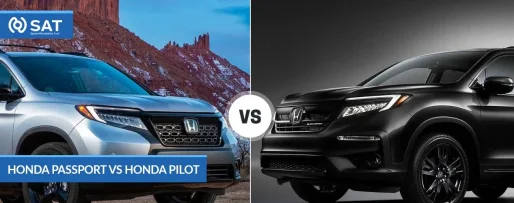
Honda is one of the first names that comes to someone’s mind when they think about cars. Having successfully produced numerous car models that are loved by car fanatics worldwide, it has become a name synonymous with reliability and innovation in the auto industry. In this blog, we will do a car comparison between the debate of Honda Passport vs Honda Pilot, to help our customers choose exactly which car would suit them better.
The 2024 Honda Pilot is larger with more seating capacity and advanced features compared to the Honda Passport. The Pilot offers more cargo space and luxury options, while the Passport is more compact and cost-effective.
For the start of Passport vs. Pilot, let us take a look at the first model of the Honda Passport that was launched in 1994. This SUV was the first of a total of three Honda Passport generations, with modifications occurring with every launch. The features of the 2023 Honda Passport are discussed below.
Space
The Honda Passport has comfortable leather-trimmed seats for five people, including two heated front seats. This vehicle has a spacious interior with ample cargo space. If the rear seats are folded down, the car has a massive trunk space of 77.7 cubic feet.
Safety
The Honda Passport has an impressive total of eight airbags. For child safety, this car is equipped with ISOFIX child seat anchors, a system that uses anchor points to secure the child seat. Other safety features include an immobilizer, child locks, vehicle stability control, and downhill assist control. Additionally, understanding driving hand signals can further enhance safety on the road by ensuring clear communication with other drivers, complementing the Passport’s robust safety features.
Comfort features
Air conditioner, heater, and a defogger
Climate control
Power steering, power boot, power windows, power mirrors, and a power door lock
Cruise control
Armrest
Electric handbrake
Cup holders
Rear folding seats
Rear AC vents.
In summary, this vehicle has outstanding interior features, so passengers can have considerable facilities during their journey.
Now, we will see the exterior of the Honda Passport. As for the Honda Passport vs Pilot dimensions, the vehicle weighs around 1914 kgs. The vehicle has alloy wheels with a wheel size of 20 inches, ensuring that the car has a firm grip on the road and the braking process remains efficient. The Honda passport also comes with a spare tire, in case of emergencies.
The Honda Passport has a six-cylinder engine that runs on petrol. The vehicle is an impressive 3471 cc and provides a standard horsepower of 280 hp at 6600 RPM. The maximum speed of this car is 220 KM/H. The fuel capacity is 74 liters. Talking about the mileage, the Honda Passport gives a mileage of 8 KM/L in the city and 11 KM/L on the highway. Hence, this car has a high petrol consumption, a critical factor to consider before the purchase.
To find out more information about the Honda Passport or other used Japanese vehicles, visit us at SAT Japan.
The first generation of the Honda Pilot came out in April 2003. This vehicle has remained one of the top choices of big car fanatics. In contrast to the Honda Passport, the Honda Pilot is currently in its fourth generation. Due to its success, this vehicle is sold globally, including continents such as Asia, North America, and Europe. The car’s features are discussed below.
Space
The Honda Pilot is huge; it has a seating capacity of eight people. This SUV allows up to 87 cubic feet of space with the second and third rows folded.
Safety
The Pilot has front, side, side curtain air, overhead, and knee airbags, so the passengers remain safe in case of any collision. The vehicle also has child locks to prevent the door from being opened from the inside. The Honda Pilot also has a blind spot information system, which alerts the driver if anything is detected in the blind spot zone.
Luxury
These features of the Honda Pilot include color touch screens, wireless Apple car play, android auto compatibility, wireless phone charging, and an internet hotspot.
Comfort
Standard air-conditioner, heater, and defogger
Heated door mirrors
Heated steering wheel
Climate control feature
Power steering, power windows, power mirrors, and a power door lock
Smart keyless entry
Aesthetic one-touch power panoramic moonroof
Now, we will describe the exterior features of the Honda Pilot. Since this is a mid-size SUV, the vehicle’s dimensions are relatively larger than average (5.08m * 1.99m * 1.8m). The weight of the car is 2086 kgs. Similar to the Honda Passport, the Honda Pilot also has alloy wheels of 20 inches, so the road grip and braking safety are not compromised.
The Honda Pilot has a fuel-run engine with a tank capacity of 70 L. The vehicle is 3498 cc and provides a standard horsepower of 285 hp at 6100 RPM. The top speed of the car is 180 KM/H. Moving on to the mileage, the city mileage for the Honda Pilot is 8 KM/L, and the highway mileage is 11.5 KM/L. This is similar to the mileage given by the Honda Passport.
To find out more information about the Honda Pilot or other used Japanese vehicles, visit us at SAT Japan.
In this blog, we went deep into the specifications of the Honda Passport and Pilot. The major difference between the two is that of size. Whereas the Honda Pilot is considerably larger than the Honda Passport, there are many interior features in the Honda Pilot as well that are lacking in the Honda Passport.
So, now that you are equipped with that knowledge, go ahead and tell us which one you like best. Or, better yet, head to our selection and choose your favorite one!
In a Four-Wheel Drive (4WD) system, the power is distributed to all four wheels of a vehicle, which improves traction and stability across various road conditions. This can significantly benefit you if you’re driving through mud, snow, or uneven landscapes. There are a couple of primary settings within this system, called Four-High (4H) and Four-Low (4L). In this article, we will break down what’s the difference between 4H and 4L, when to use each setting, and other relevant details.
Understanding Four-Wheel Drive (4WD) Basics
Four-wheel drive (4WD) systems improve vehicle traction by distributing power to all four wheels, unlike two-wheel drive systems that only deliver power to the front or rear wheels. The transfer case is the heart of this kind of system, as it distributes power from the vehicle’s transmission to the rear and front axles.
The torque split between the axles can vary based on the system’s design and the driving conditions. This system can significantly benefit you in off-road scenarios. For instance, if you are driving through a muddy trail, a 4WD system can distribute torque to all wheels and reduce the probability of getting stuck.
What’s the Difference Between 4H and 4L?
Although both settings engage all four wheels to improve traction, there is some slight difference in 4H and 4L based on the purpose they serve according to driving conditions and speed requirements.
4H (Four-High)
When you engage the 4H, the vehicle’s front and rear axles are locked together, resulting in all four wheels being driven forward simultaneously while maintaining high-range gearing. You can use this setting if you need additional traction but do not want to give up speed, such as in wet or snowy areas, unpaved roads, or snowy paths.
4L (Four-Low)
Although activating 4L locks the front and rear axles together, it also engages additional gearing, offering more torque at significantly decreased speeds. You will need this setting when driving through challenging terrain where maximum control and power are needed.
Some use cases of 4L include steep inclines or declines, such as tackling a steep, rocky hill during an off-road adventure. This setting can also help you get out of heavy snow or deep mud pits.
Many modern SUVs, such as luxury models like the 2025 BMW X5, use intelligent all-wheel-drive systems that automatically adjust torque distribution based on driving conditions.
4 Wheel High vs Low: When to Use Each Setting
You must engage the correct four-wheel-drive (4WD) to ensure your vehicle performs well and remains safe in various driving conditions. See the table below to understand whether to use 4 wheel high vs low in each situation and how it would help.
Scenario
Recommended Setting
Reason
Wet pavement
4H
Enhances traction and stability at moderate speeds.
Snowy or icy roads
4H
Provides balanced power for improved control on slippery surfaces.
Deep snow or steep icy inclines/declines
4L
Delivers maximum torque and controlled speed for challenging conditions.
Moderate steep inclines/declines
4H
Maintains momentum on firm surfaces.
Steep, loose, or uneven inclines/declines
4L
Offers increased torque and engine braking for safe navigation.
Shallow mud or sand
4H
Helps maintain higher speeds to prevent bogging down.
Deep mud or sand
4L
Ensures slow, deliberate movement to maintain traction.
Towing on smooth surfaces with some slip
4H
Allows for normal speed maintenance with added traction.
Towing on rough, uneven terrain
4L
Provides maximum torque and control for safe maneuvering.
Common Misconceptions About 4H and 4L
Misconception 1: "You Can Use 4L on the Highway"
It’s not recommended to use 4L on highways, as it can cause severe drivetrain damage. This setting is designed for low-speed, high-torque situations like deep mud or rocky terrains. On a highway, the vehicle will operate at extremely high engine RPMs with limited speed, which can waste fuel and cause mechanical strain.
Misconception 2: "4H Improves Fuel Economy"
4H actually provides better traction on slippery surfaces, but it does not improve fuel economy in any way. Using it on dry surfaces can produce excessive noise and cause severe tire wear. If you drive it on a clear and well-paved road, it can lead to increased drivetrain drag and higher fuel consumption.
Tips for Switching Between 4 Low vs 4 High Safely
Shifting from 2H to 4H
You can generally shift from 2H to 4H while moving, generally up to the speeds of 55 mph. When the vehicle is moving straight, release the accelerator pedal, engage the 4WD selector to 4H, and then resume acceleration. It’s also possible to shift into 4H when the vehicle is stationary.
Shifting from 4H to 4L
You must bring your vehicle to a complete stop before shifting from 4H to 4L or slowing it down to crawl. If you have an automatic transmission, you can shift the gear lever to Neutral (N). If it’s a manual transmission, depress the clutch pedal. Then, firmly move the 4WD selector to 4L without pausing in neutral. Once engaged, return the transmission to Drive (D).
Shifting from 4L to 4H
It’s also important to stop your vehicle completely or slow it down to a crawl before shifting from 4L to 4H. Once it’s stopped, shift the transmission to Neutral (N) or depress the clutch pedal. Then, move the 4WD selector from 4L to 4H. You can then return the transmission to Drive (D) or the suitable gear and continue driving.
Conclusion
Knowing when to use 4H vs. 4L can significantly improve your vehicle’s performance across difficult terrains. Although 4H provides better traction at a normal speed for loose surfaces, 4L is the right option if you need maximum torque. There is a slight difference in 4H and 4L, and you must use the right setting for the right situation to keep yourself safe and avoid drivetrain damage to your vehicle.
SAT Japan has a comprehensive list of used and new japanese vehicles that you can explore to find the ideal one for your situation. You can filter the results based on your budget, car type, make, model year, and other relevant factors.


